Edit: this post has been edited to clarify crawling behavior with respect to site guidance.
You can now crawl an entire website with a single API call using Browser Rendering's new /crawl endpoint, available in open beta. Submit a starting URL, and pages are automatically discovered, rendered in a headless browser, and returned in multiple formats, including HTML, Markdown, and structured JSON. The endpoint is a verified bot (intermediary agent) that respects robots.txt and AI Crawl Control ↗ by default, making it easy for developers to comply with website rules, and making it less likely for crawlers to ignore web-owner guidance. This is great for training models, building RAG pipelines, and researching or monitoring content across a site.
Crawl jobs run asynchronously. You submit a URL, receive a job ID, and check back for results as pages are processed.
Multiple output formats - Return crawled content as HTML, Markdown, and structured JSON (powered by Workers AI)
Crawl scope controls - Configure crawl depth, page limits, and wildcard patterns to include or exclude specific URL paths
Automatic page discovery - Discovers URLs from sitemaps, page links, or both
Incremental crawling - Use modifiedSince and maxAge to skip pages that haven't changed or were recently fetched, saving time and cost on repeated crawls
Static mode - Set render: false to fetch static HTML without spinning up a browser, for faster crawling of static sites
Well-behaved bot - Honors robots.txt directives, including crawl-delay
Available on both the Workers Free and Paid plans.
Note: the /crawl endpoint cannot bypass Cloudflare bot detection or captchas, and self-identifies as a bot.
Cloudflare Workflows allows you to configure specific retry logic for each step in your workflow execution. Now, you can access which retry attempt is currently executing for calls to step.do():
await step.do("my-step", async (ctx) => { // ctx.attempt is 1 on first try, 2 on first retry, etc. console.log(`Attempt ${ctx.attempt}`);});
You can use the step context for improved logging & observability, progressive backoff, or conditional logic in your workflow definition.
Note that the current attempt number is 1-indexed. For more information on retry behavior, refer to Sleeping and Retrying.
During a meeting, participant audio is routed through AI Gateway to Nova-3 on Workers AI — so transcription runs on Cloudflare's network end-to-end, reducing latency compared to routing through external speech-to-text services.
Set the language when creating a meeting via ai_config.transcription.language:
Supported languages include English, Spanish, French, German, Hindi, Russian, Portuguese, Japanese, Italian, and Dutch — with regional variants like en-AU, en-GB, en-IN, en-NZ, es-419, fr-CA, de-CH, pt-BR, and pt-PT. Use multi for automatic multilingual detection.
If you are building voice agents or real-time translation workflows, your agent can now transcribe in the caller's language natively — no extra services or routing logic needed.
Browser Rendering REST API rate limits for Workers Paid plans have been increased from 3 requests per second (180/min) to 10 requests per second (600/min). No action is needed to benefit from the higher limit.
The REST API lets you perform common browser tasks with a single API call, and you can now do it at a higher rate.
Previously, each instance was limited to 1,024 steps. Now, Workflows can support more complex, long-running executions without the additional complexity of recursive or child workflow calls.
Note that the maximum persisted state limit per Workflow instance remains 100 MB for Workers Free and 1 GB for Workers Paid. Refer to Workflows limits for more information.
Sandboxes now support real-time filesystem watching via sandbox.watch(). The method returns a Server-Sent Events ↗ stream backed by native inotify, so your Worker receives create, modify, delete, and move events as they happen inside the container.
sandbox.watch(path, options)
Pass a directory path and optional filters. The returned stream is a standard ReadableStream you can proxy directly to a browser client or consume server-side.
// Stream events to a browser clientconst stream = await sandbox.watch("/workspace/src", { recursive: true, include: ["*.ts", "*.js"],});return new Response(stream, { headers: { "Content-Type": "text/event-stream" },});
// Stream events to a browser clientconst stream = await sandbox.watch("/workspace/src", { recursive: true, include: ["*.ts", "*.js"],});return new Response(stream, { headers: { "Content-Type": "text/event-stream" },});
Server-side consumption with parseSSEStream
Use parseSSEStream to iterate over events inside a Worker without forwarding them to a client.
import { parseSSEStream } from "@cloudflare/sandbox";import type { FileWatchSSEEvent } from "@cloudflare/sandbox";const stream = await sandbox.watch("/workspace/src", { recursive: true });for await (const event of parseSSEStream<FileWatchSSEEvent>(stream)) { console.log(event.type, event.path);}
Each event includes a type field (create, modify, delete, or move) and the affected path. Move events also include a from field with the original path.
Options
Option
Type
Description
recursive
boolean
Watch subdirectories. Defaults to false.
include
string[]
Glob patterns to filter events. Omit to receive all events.
The latest release of the Agents SDK ↗ rewrites observability from scratch with diagnostics_channel, adds keepAlive() to prevent Durable Object eviction during long-running work, and introduces waitForMcpConnections so MCP tools are always available when onChatMessage runs.
Observability rewrite
The previous observability system used console.log() with a custom Observability.emit() interface. v0.7.0 replaces it with structured events published to diagnostics channels — silent by default, zero overhead when nobody is listening.
Every event has a type, payload, and timestamp. Events are routed to seven named channels:
Use the typed subscribe() helper from agents/observability for type-safe access:
import { subscribe } from "agents/observability";const unsub = subscribe("rpc", (event) => { if (event.type === "rpc") { console.log(`RPC call: ${event.payload.method}`); } if (event.type === "rpc:error") { console.error( `RPC failed: ${event.payload.method} — ${event.payload.error}`, ); }});// Clean up when doneunsub();
import { subscribe } from "agents/observability";const unsub = subscribe("rpc", (event) => { if (event.type === "rpc") { console.log(`RPC call: ${event.payload.method}`); } if (event.type === "rpc:error") { console.error( `RPC failed: ${event.payload.method} — ${event.payload.error}`, ); }});// Clean up when doneunsub();
In production, all diagnostics channel messages are automatically forwarded to Tail Workers — no subscription code needed in the agent itself:
export default { async tail(events) { for (const event of events) { for (const msg of event.diagnosticsChannelEvents) { // msg.channel is "agents:rpc", "agents:workflow", etc. console.log(msg.timestamp, msg.channel, msg.message); } } },};
export default { async tail(events) { for (const event of events) { for (const msg of event.diagnosticsChannelEvents) { // msg.channel is "agents:rpc", "agents:workflow", etc. console.log(msg.timestamp, msg.channel, msg.message); } } },};
The custom Observability override interface is still supported for users who need to filter or forward events to external services.
Durable Objects are evicted after a period of inactivity (typically 70-140 seconds with no incoming requests, WebSocket messages, or alarms). During long-running operations — streaming LLM responses, waiting on external APIs, running multi-step computations — the agent can be evicted mid-flight.
keepAlive() prevents this by creating a 30-second heartbeat schedule. The alarm firing resets the inactivity timer. Returns a disposer function that cancels the heartbeat when called.
AIChatAgent now waits for MCP server connections to settle before calling onChatMessage. This ensures this.mcp.getAITools() returns the full set of tools, especially after Durable Object hibernation when connections are being restored in the background.
For lower-level control, call this.mcp.waitForConnections() directly inside onChatMessage instead.
Other improvements
MCP deduplication by name and URL — addMcpServer with HTTP transport now deduplicates on both server name and URL. Calling it with the same name but a different URL creates a new connection. URLs are normalized before comparison (trailing slashes, default ports, hostname case).
callbackHost optional for non-OAuth servers — addMcpServer no longer requires callbackHost when connecting to MCP servers that do not use OAuth.
MCP URL security — Server URLs are validated before connection to prevent SSRF. Private IP ranges, loopback addresses, link-local addresses, and cloud metadata endpoints are blocked.
Custom denial messages — addToolOutput now supports state: "output-error" with errorText for custom denial messages in human-in-the-loop tool approval flows.
requestId in chat options — onChatMessage options now include a requestId for logging and correlating events.
You can now start using AI Gateway with a single API call — no setup required. Use default as your gateway ID, and AI Gateway creates one for you automatically on the first request.
To try it out, create an API token with AI Gateway - Read, AI Gateway - Edit, and Workers AI - Read permissions, then run:
AI Gateway gives you logging, caching, rate limiting, and access to multiple AI providers through a single endpoint. For more information, refer to Get started.
The latest release of the Agents SDK ↗ lets you define an Agent and an McpAgent in the same Worker and connect them over RPC — no HTTP, no network overhead. It also makes OAuth opt-in for simple MCP connections, hardens the schema converter for production workloads, and ships a batch of @cloudflare/ai-chat reliability fixes.
RPC transport for MCP
You can now connect an Agent to an McpAgent in the same Worker using a Durable Object binding instead of an HTTP URL. The connection stays entirely within the Cloudflare runtime — no network round-trips, no serialization overhead.
Pass the Durable Object namespace directly to addMcpServer:
import { Agent } from "agents";export class MyAgent extends Agent { async onStart() { // Connect via DO binding — no HTTP, no network overhead await this.addMcpServer("counter", env.MY_MCP); // With props for per-user context await this.addMcpServer("counter", env.MY_MCP, { props: { userId: "user-123", role: "admin" }, }); }}
import { Agent } from "agents";export class MyAgent extends Agent { async onStart() { // Connect via DO binding — no HTTP, no network overhead await this.addMcpServer("counter", env.MY_MCP); // With props for per-user context await this.addMcpServer("counter", env.MY_MCP, { props: { userId: "user-123", role: "admin" }, }); }}
The addMcpServer method now accepts string | DurableObjectNamespace as the second parameter with full TypeScript overloads, so HTTP and RPC paths are type-safe and cannot be mixed.
Key capabilities:
Hibernation support — RPC connections survive Durable Object hibernation automatically. The binding name and props are persisted to storage and restored on wake-up, matching the behavior of HTTP MCP connections.
Deduplication — Calling addMcpServer with the same server name returns the existing connection instead of creating duplicates. Connection IDs are stable across hibernation restore.
Smaller surface area — The RPC transport internals have been rewritten and reduced from 609 lines to 245 lines. RPCServerTransport now uses JSONRPCMessageSchema from the MCP SDK for validation instead of hand-written checks.
Optional OAuth for MCP connections
addMcpServer() no longer eagerly creates an OAuth provider for every connection. For servers that do not require authentication, a simple call is all you need:
// No callbackHost, no OAuth config — just worksawait this.addMcpServer("my-server", "https://mcp.example.com");
// No callbackHost, no OAuth config — just worksawait this.addMcpServer("my-server", "https://mcp.example.com");
If the server responds with a 401, the SDK throws a clear error: "This MCP server requires OAuth authentication. Provide callbackHost in addMcpServer options to enable the OAuth flow." The restore-from-storage flow also handles missing callback URLs gracefully, skipping auth provider creation for non-OAuth servers.
Hardened JSON Schema to TypeScript converter
The schema converter used by generateTypes() and getAITools() now handles edge cases that previously caused crashes in production:
Depth and circular reference guards — Prevents stack overflows on recursive or deeply nested schemas
Tuple support — prefixItems (JSON Schema 2020-12) and array items (draft-07)
OpenAPI 3.0 nullable: true — Supported across all schema branches
Per-tool error isolation — One malformed schema cannot crash the full pipeline in generateTypes() or getAITools()
Missing inputSchema fallback — getAITools() falls back to { type: "object" } instead of throwing
@cloudflare/ai-chat fixes
Tool denial flow — Denied tool approvals (approved: false) now transition to output-denied with a tool_result, fixing Anthropic provider compatibility. Custom denial messages are supported via state: "output-error" and errorText.
Abort/cancel support — Streaming responses now properly cancel the reader loop when the abort signal fires and send a done signal to the client.
Duplicate message persistence — persistMessages() now reconciles assistant messages by content and order, preventing duplicate rows when clients resend full history.
requestId in OnChatMessageOptions — Handlers can now send properly-tagged error responses for pre-stream failures.
redacted_thinking preservation — The message sanitizer no longer strips Anthropic redacted_thinking blocks.
/get-messages reliability — Endpoint handling moved from a prototype onRequest() override to a constructor wrapper, so it works even when users override onRequest without calling super.onRequest().
Client tool APIs undeprecated — createToolsFromClientSchemas, clientTools, AITool, extractClientToolSchemas, and the tools option on useAgentChat are restored for SDK use cases where tools are defined dynamically at runtime.
jsonSchema initialization — Fixed jsonSchema not initialized error when calling getAITools() in onChatMessage.
You can now run more Containers concurrently with significantly higher limits on memory, vCPU, and disk.
Limit
Previous Limit
New Limit
Memory for concurrent live Container instances
400GiB
6TiB
vCPU for concurrent live Container instances
100
1,500
Disk for concurrent live Container instances
2TB
30TB
This 15x increase enables larger-scale workloads on Containers. You can now run 15,000 instances of the lite instance type, 6,000 instances of basic, over 1,500 instances of standard-1, or over 1,000 instances of standard-2 concurrently.
Refer to Limits for more details on the available instance types and limits.
Pywrangler ↗, the CLI tool for managing Python Workers and packages,
now supports Windows, allowing you to develop and deploy Python Workers from Windows environments.
Previously, Pywrangler was only available on macOS and Linux.
You can install and use Pywrangler on Windows the same way you would on other platforms.
Specify your Worker's Python dependencies in your pyproject.toml file,
then use the following commands to develop and deploy:
All existing Pywrangler functionality, including package management, local development, and deployment, works on Windows without any additional configuration.
Requirements
This feature requires the following minimum versions:
wrangler >= 4.64.0
workers-py >= 1.72.0
uv >= 0.29.8
To upgrade workers-py (which includes Pywrangler) in your project, run:
uv tool upgrade workers-py
To upgrade wrangler, run:
npm install -g wrangler@latest
To upgrade uv, run:
uv self update
To get started with Python Workers on Windows, refer to the Python packages documentation for full details on Pywrangler.
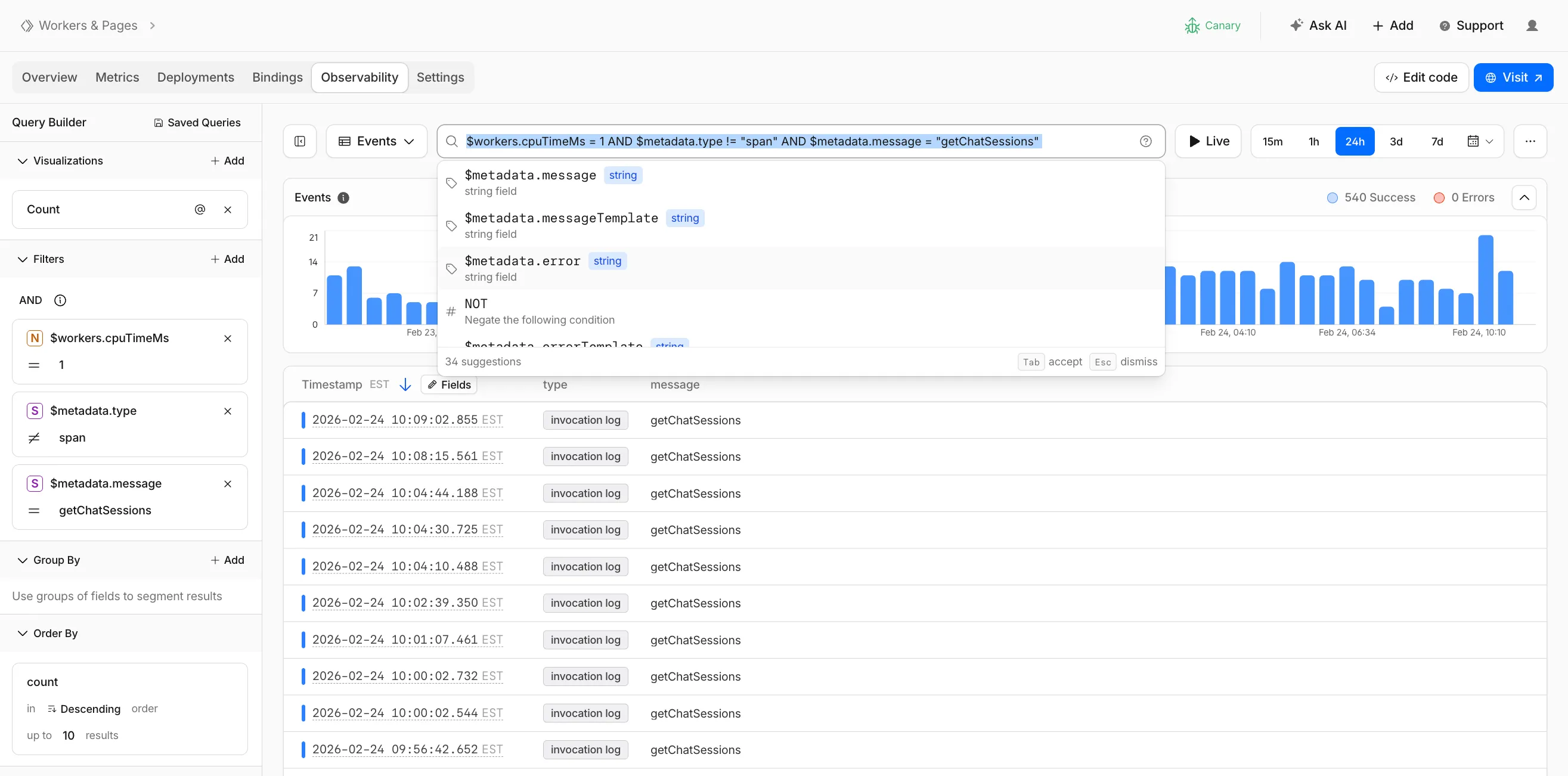
Workers Observability now includes a query language that lets you write structured queries directly in the search bar to filter your logs and traces. The search bar doubles as a free text search box — type any term to search across all metadata and attributes, or write field-level queries for precise filtering.
Queries written in the search bar sync with the Query Builder sidebar, so you can write a query by hand and then refine it visually, or build filters in the Query Builder and see the corresponding query syntax. The search bar provides autocomplete suggestions for metadata fields and operators as you type.
The query language supports:
Free text search — search everywhere with a keyword like error, or match an exact phrase with "exact phrase"
Field queries — filter by specific fields using comparison operators (for example, status = 500 or $workers.wallTimeMs > 100)
Operators — =, !=, >, >=, <, <=, and : (contains)
Functions — contains(field, value), startsWith(field, prefix), regex(field, pattern), and exists(field)
Boolean logic — add conditions with AND, OR, and NOT
Select the help icon next to the search bar to view the full syntax reference, including all supported operators, functions, and keyboard shortcuts.
deleteAll() now deletes a Durable Object alarm in addition to stored data for Workers with a compatibility date of 2026-02-24 or later. This change simplifies clearing a Durable Object's storage with a single API call.
Previously, deleteAll() only deleted user-stored data for an object. Alarm usage stores metadata in an object's storage, which required a separate deleteAlarm() call to fully clean up all storage for an object. The deleteAll() change applies to both KV-backed and SQLite-backed Durable Objects.
// Before: two API calls required to clear all storageawait this.ctx.storage.deleteAlarm();await this.ctx.storage.deleteAll();// Now: a single call clears both data and the alarmawait this.ctx.storage.deleteAll();
Cloudflare Pipelines ingests streaming data via Workers or HTTP endpoints, transforms it with SQL, and writes it to R2 as Apache Iceberg tables. Today we're shipping three improvements to help you understand why streaming events get dropped, catch data quality issues early, and set up Pipelines faster.
Dropped event metrics
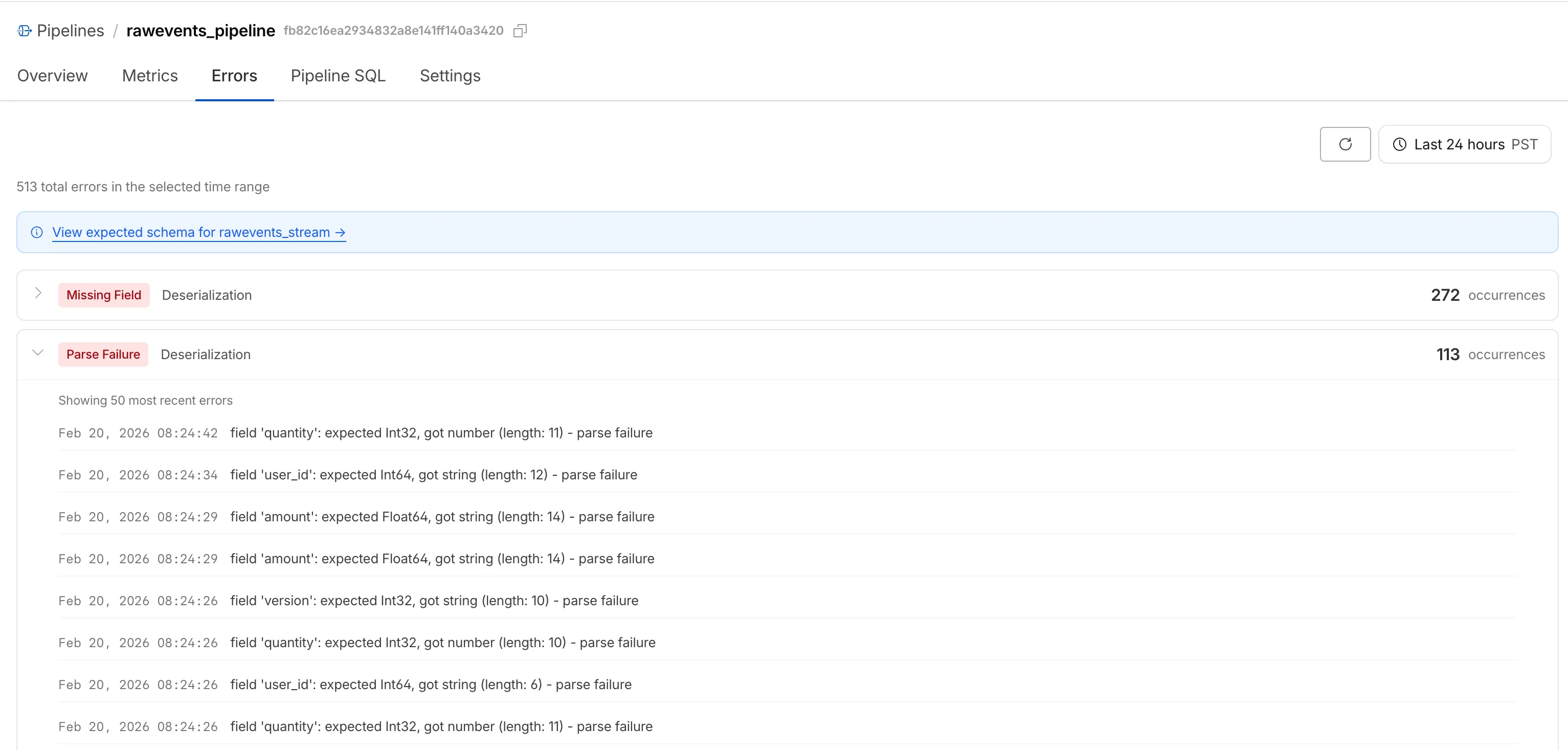
When stream events don't match the expected schema, Pipelines accepts them during ingestion but drops them when attempting to deliver them to the sink. To help you identify the root cause of these issues, we are introducing a new dashboard and metrics that surface dropped events with detailed error messages.
Dropped events can also be queried programmatically via the new pipelinesUserErrorsAdaptiveGroups GraphQL dataset. The dataset breaks down failures by specific error type (missing_field, type_mismatch, parse_failure, or null_value) so you can trace issues back to the source.
For the full list of dimensions, error types, and additional query examples, refer to User error metrics.
Typed Pipelines bindings
Sending data to a Pipeline from a Worker previously used a generic Pipeline<PipelineRecord> type, which meant schema mismatches (wrong field names, incorrect types) were only caught at runtime as dropped events.
Running wrangler types now generates schema-specific TypeScript types for your Pipeline bindings. TypeScript catches missing required fields and incorrect field types at compile time, before your code is deployed.
Setting up a new Pipeline previously required multiple manual steps: creating an R2 bucket, enabling R2 Data Catalog, generating an API token, and configuring format, compression, and rolling policies individually.
The wrangler pipelines setup command now offers a Simple setup mode that applies recommended defaults and automatically creates the R2 bucket and enables R2 Data Catalog if they do not already exist. Validation errors during setup prompt you to retry inline rather than restarting the entire process.
You can now disable a live input to reject incoming RTMPS and SRT
connections. When a live input is disabled, any broadcast attempts will fail to
connect.
This gives you more control over your live inputs:
Temporarily pause an input without deleting it
Programmatically end creator broadcasts
Prevent new broadcasts from starting on a specific input
To disable a live input via the API, set the enabled property to false:
Sandboxes now support createBackup() and restoreBackup() methods for creating and restoring point-in-time snapshots of directories.
This allows you to restore environments quickly. For instance, in order to develop in a sandbox, you may need to include a user's codebase and run a build step.
Unfortunately git clone and npm install can take minutes, and you don't want to run these steps every time the user starts their sandbox.
Now, after the initial setup, you can just call createBackup(), then restoreBackup() the next time this environment is needed. This makes it practical to pick up exactly
where a user left off, even after days of inactivity, without repeating expensive setup steps.
const sandbox = getSandbox(env.Sandbox, "my-sandbox");// Make non-trivial changes to the file systemawait sandbox.gitCheckout(endUserRepo, { targetDir: "/workspace" });await sandbox.exec("npm install", { cwd: "/workspace" });// Create a point-in-time backup of the directoryconst backup = await sandbox.createBackup({ dir: "/workspace" });// Store the handle for later useawait env.KV.put(`backup:${userId}`, JSON.stringify(backup));// ... in a future session...// Restore instead of re-cloning and reinstallingawait sandbox.restoreBackup(backup);
Backups are stored in R2 and can take advantage of R2 object lifecycle rules to ensure they do not persist forever.
Key capabilities:
Persist and reuse across sandbox sessions — Easily store backup handles in KV, D1, or Durable Object storage for use in subsequent sessions
Usable across multiple instances — Fork a backup across many sandboxes for parallel work
Named backups — Provide optional human-readable labels for easier management
TTLs — Set time-to-live durations so backups are automatically removed from storage once they are no longer needed
Hyperdrive now treats queries containing PostgreSQL STABLE functions as uncacheable, in addition to VOLATILE functions.
Previously, only functions that PostgreSQL categorizes ↗ as VOLATILE (for example, RANDOM(), LASTVAL()) were detected as uncacheable. STABLE functions (for example, NOW(), CURRENT_TIMESTAMP, CURRENT_DATE) were incorrectly allowed to be cached.
Because STABLE functions can return different results across different SQL statements within the same transaction, caching their results could serve stale or incorrect data. This change aligns Hyperdrive's caching behavior with PostgreSQL's function volatility semantics.
If your queries use STABLE functions, and you were relying on them being cached, move the function call to your application code and pass the result as a query parameter. For example, instead of WHERE created_at > NOW(), compute the timestamp in your Worker and pass it as WHERE created_at > $1.
Hyperdrive uses text-based pattern matching to detect uncacheable functions. References to function names like NOW() in SQL comments also cause the query to be marked as uncacheable.
The @cloudflare/codemode ↗ package has been rewritten into a modular, runtime-agnostic SDK.
Code Mode ↗ enables LLMs to write and execute code that orchestrates your tools, instead of calling them one at a time. This can (and does) yield significant token savings, reduces context window pressure and improves overall model performance on a task.
The new Executor interface is runtime agnostic and comes with a prebuilt DynamicWorkerExecutor to run generated code in a Dynamic Worker Loader.
Breaking changes
Removed experimental_codemode() and CodeModeProxy — the package no longer owns an LLM call or model choice
New import path: createCodeTool() is now exported from @cloudflare/codemode/ai
New features
createCodeTool() — Returns a standard AI SDK Tool to use in your AI agents.
Executor interface — Minimal execute(code, fns) contract. Implement for any code sandboxing primitive or runtime.
DynamicWorkerExecutor
Runs code in a Dynamic Worker. It comes with the following features:
Network isolation — fetch() and connect() blocked by default (globalOutbound: null) when using DynamicWorkerExecutor
Console capture — console.log/warn/error captured and returned in ExecuteResult.logs
Execution timeout — Configurable via timeout option (default 30s)
Usage
import { createCodeTool } from "@cloudflare/codemode/ai";import { DynamicWorkerExecutor } from "@cloudflare/codemode";import { streamText } from "ai";const executor = new DynamicWorkerExecutor({ loader: env.LOADER });const codemode = createCodeTool({ tools: myTools, executor });const result = streamText({ model, tools: { codemode }, messages,});
import { createCodeTool } from "@cloudflare/codemode/ai";import { DynamicWorkerExecutor } from "@cloudflare/codemode";import { streamText } from "ai";const executor = new DynamicWorkerExecutor({ loader: env.LOADER });const codemode = createCodeTool({ tools: myTools, executor });const result = streamText({ model, tools: { codemode }, messages,});

Cloudflare Tunnel is now available in the main Cloudflare Dashboard at Networking > Tunnels ↗, bringing first-class Tunnel management to developers using Tunnel for securing origin servers.
This new experience provides everything you need to manage Tunnels for public applications, including:
Full Tunnel lifecycle management: Create, configure, delete, and monitor all your Tunnels in one place.
Native integrations: View Tunnels by name when configuring DNS records and Workers VPC — no more copy-pasting UUIDs.
Real-time visibility: Monitor replicas and Tunnel health status directly in the dashboard.
Workers AI and AI Gateway have received a series of dashboard improvements to help you get started faster and manage your AI workloads more easily.
Navigation and discoverability
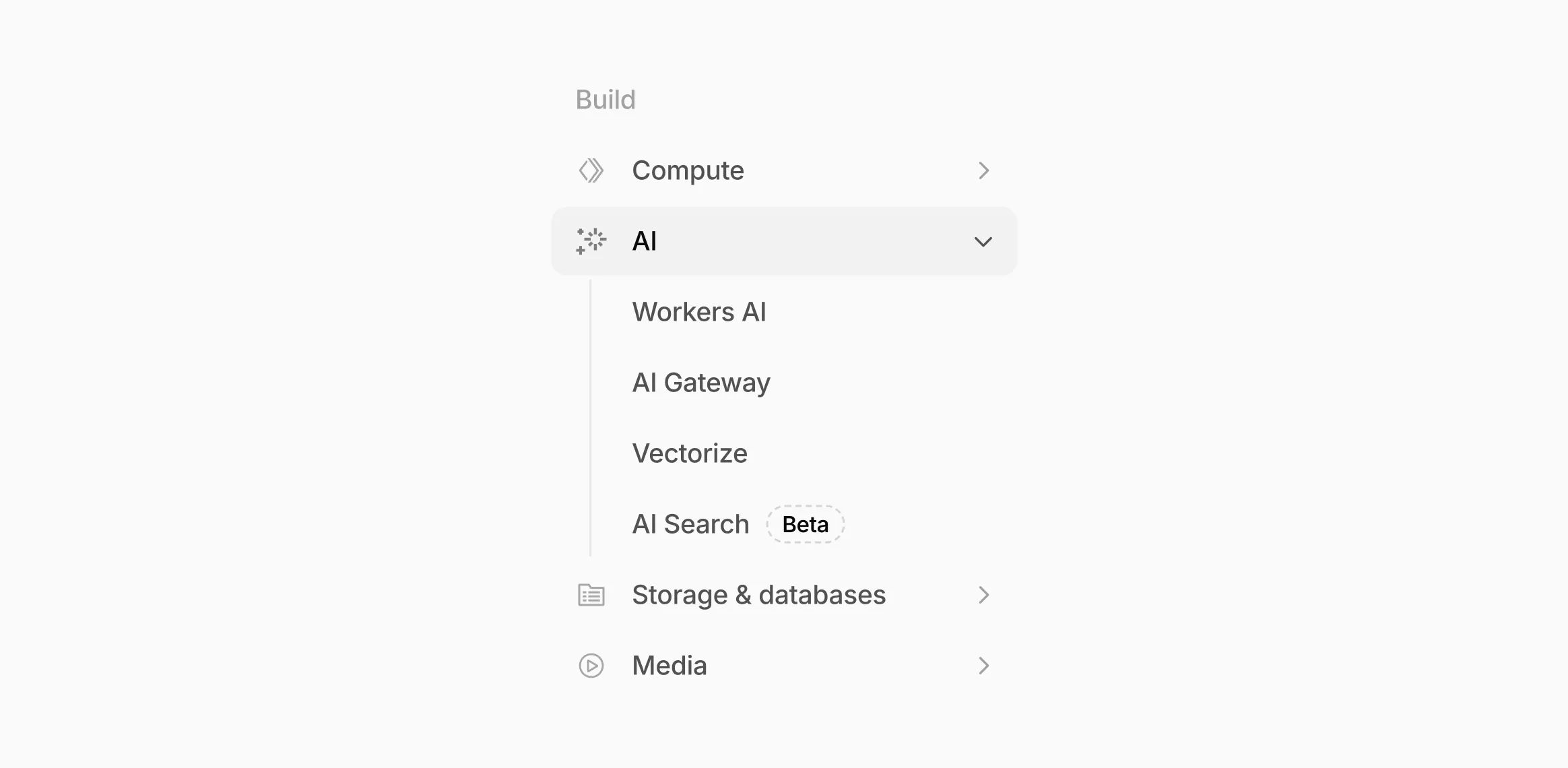
AI now has its own top-level section in the Cloudflare dashboard sidebar, so you can find AI features without digging through menus.
The new top-level AI section in the dashboard sidebar.
Onboarding and getting started
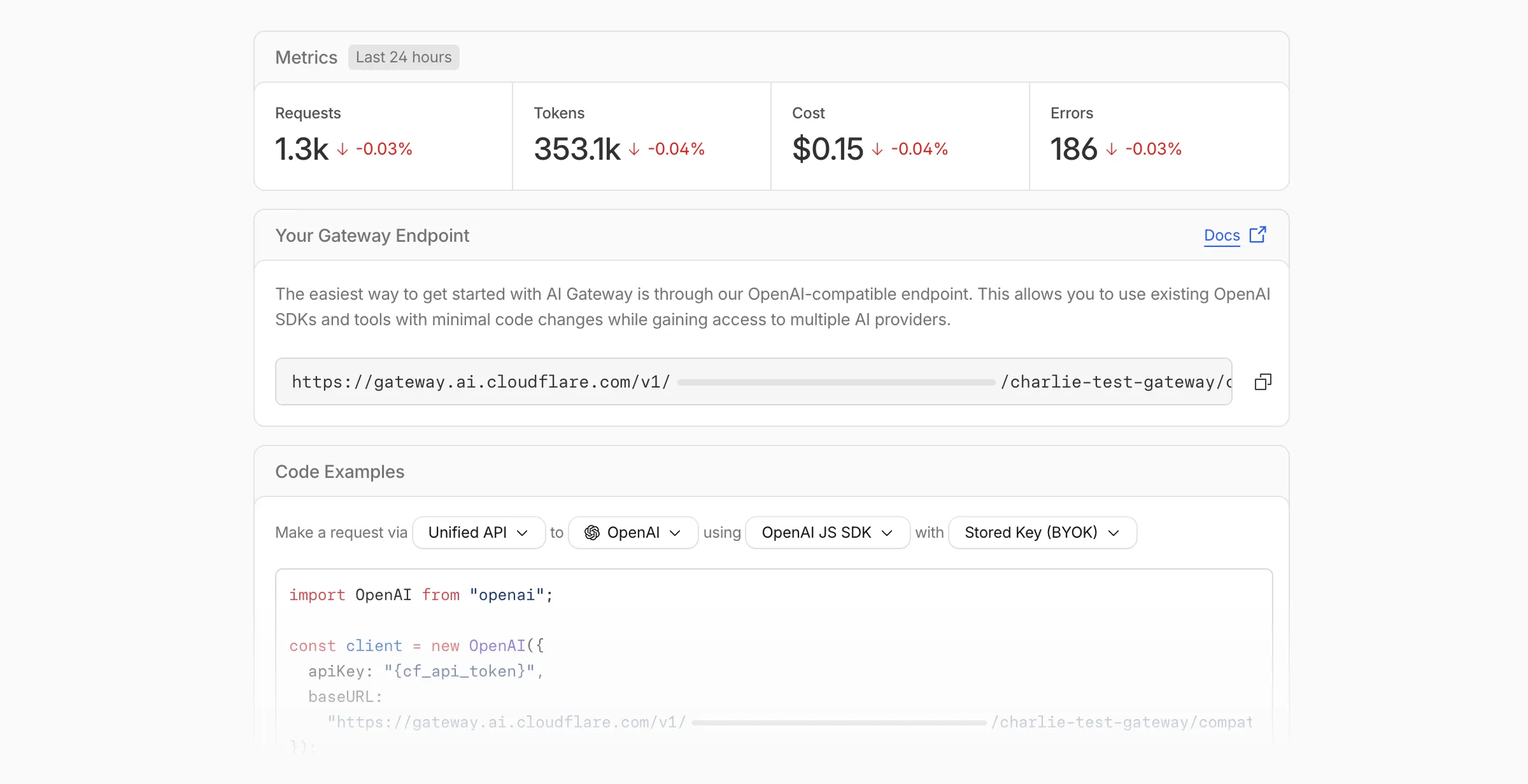
Getting started with AI Gateway is now simpler. When you create your first gateway, we now show your gateway's OpenAI-compatible endpoint and step-by-step guidance to help you configure it. The Playground also includes helpful prompts, and usage pages have clear next steps if you have not made any requests yet.
The first-run setup experience for new gateways.
We've also combined the previously separate code example sections into one view with dropdown selectors for API type, provider, SDK, and authentication method so you can now customize the exact code snippet you need from one place.
Dynamic Routing
The route builder is now more performant and responsive.
You can now copy route names to your clipboard with a single click.
Code examples use the Universal Endpoint format, making it easier to integrate routes into your application.
Observability and analytics
Small monetary values now display correctly in cost analytics charts, so you can accurately track spending at any scale.
Accessibility
Improvements to keyboard navigation within the AI Gateway, specifically when exploring usage by provider.
Improvements to sorting and filtering components on the Workers AI models page.
The latest release of the Agents SDK ↗ adds built-in retry utilities, per-connection protocol message control, and a fully rewritten @cloudflare/ai-chat with data parts, tool approval persistence, and zero breaking changes.
Retry utilities
A new this.retry() method lets you retry any async operation with exponential backoff and jitter. You can pass an optional shouldRetry predicate to bail early on non-retryable errors.
Retry options are validated eagerly at enqueue/schedule time, and invalid values throw immediately. Internal retries have also been added for workflow operations (terminateWorkflow, pauseWorkflow, and others) with Durable Object-aware error detection.
Per-connection protocol message control
Agents automatically send JSON text frames (identity, state, MCP server lists) to every WebSocket connection. You can now suppress these per-connection for clients that cannot handle them — binary-only devices, MQTT clients, or lightweight embedded systems.
Connections with protocol messages disabled still fully participate in RPC and regular messaging. Use isConnectionProtocolEnabled(connection) to check a connection's status at any time. The flag persists across Durable Object hibernation.
The first stable release of @cloudflare/ai-chat ships alongside this release with a major refactor of AIChatAgent internals — new ResumableStream class, WebSocket ChatTransport, and simplified SSE parsing — with zero breaking changes. Existing code using AIChatAgent and useAgentChat works as-is.
Key new features:
Data parts — Attach typed JSON blobs (data-*) to messages alongside text. Supports reconciliation (type+id updates in-place), append, and transient parts (ephemeral via onData callback). See Data parts.
Tool approval persistence — The needsApproval approval UI now survives page refresh and DO hibernation. The streaming message is persisted to SQLite when a tool enters approval-requested state.
maxPersistedMessages — Cap SQLite message storage with automatic oldest-message deletion.
body option on useAgentChat — Send custom data with every request (static or dynamic).
Incremental persistence — Hash-based cache to skip redundant SQL writes.
Row size guard — Automatic two-pass compaction when messages approach the SQLite 2 MB limit.
autoContinueAfterToolResult defaults to true — Client-side tool results and tool approvals now automatically trigger a server continuation, matching server-executed tool behavior. Set autoContinueAfterToolResult: false in useAgentChat to restore the previous behavior.
Notable bug fixes:
Resolved stream resumption race conditions
Resolved an issue where setMessages functional updater sent empty arrays
Resolved an issue where client tool schemas were lost after DO hibernation
Resolved InvalidPromptError after tool approval (approval.id was dropped)
Resolved an issue where message metadata was not propagated on broadcast/resume paths
Resolved an issue where clearAll() did not clear in-memory chunk buffers
Resolved an issue where reasoning-delta silently dropped data when reasoning-start was missed during stream resumption
Synchronous queue and schedule getters
getQueue(), getQueues(), getSchedule(), dequeue(), dequeueAll(), and dequeueAllByCallback() were unnecessarily async despite only performing synchronous SQL operations. They now return values directly instead of wrapping them in Promises. This is backward compatible — existing code using await on these methods will continue to work.
Other improvements
Fix TypeScript "excessively deep" error — A depth counter on CanSerialize and IsSerializableParam types bails out to true after 10 levels of recursion, preventing the "Type instantiation is excessively deep" error with deeply nested types like AI SDK CoreMessage[].
POST SSE keepalive — The POST SSE handler now sends event: ping every 30 seconds to keep the connection alive, matching the existing GET SSE handler behavior. This prevents POST response streams from being silently dropped by proxies during long-running tool calls.
Widened peer dependency ranges — Peer dependency ranges across packages have been widened to prevent cascading major bumps during 0.x minor releases. @cloudflare/ai-chat and @cloudflare/codemode are now marked as optional peer dependencies.
Sandboxes and Containers now support running Docker for "Docker-in-Docker" setups. This is particularly useful when your end users or agents want to run a full sandboxed development environment.
This allows you to:
Develop containerized applications with your Sandbox
Run isolated test environments for images
Build container images as part of CI/CD workflows
Deploy arbitrary images supplied at runtime within a container
Cloudflare has deprecated the Workers Quick Editor dev tools inspector and replaced it with a lightweight log viewer.
This aligns our logging with wrangler tail and gives us the opportunity to focus our efforts on bringing benefits from the work we have invested in observability, which would not be possible otherwise.
We have made improvements to this logging viewer based on your feedback such that you can log object and array types, and easily clear the list of logs. This does not include class instances. Limitations are documented in the Workers Playground docs.
If you do need to develop your Worker with a remote inspector, you can still do this using Wrangler locally. Cloning a project from your quick editor to your computer for local development can be done with the wrangler init --from-dash command. For more information, refer to Wrangler commands.



 The new top-level AI section in the dashboard sidebar.
 The first-run setup experience for new gateways.