A new Workers Best Practices guide provides opinionated recommendations for building fast, reliable, observable, and secure Workers. The guide draws on production patterns, Cloudflare internal usage, and best practices observed from developers building on Workers.
Key guidance includes:
Keep your compatibility date current and enable nodejs_compat — Ensure you have access to the latest runtime features and Node.js built-in modules.
{ "name": "my-worker", "main": "src/index.ts", // Set this to today's date "compatibility_date": "2026-07-20", "compatibility_flags": ["nodejs_compat"],}
name = "my-worker"main = "src/index.ts"# Set this to today's datecompatibility_date = "2026-07-20"compatibility_flags = [ "nodejs_compat" ]
Generate binding types with wrangler types — Never hand-write your Env interface. Let Wrangler generate it from your actual configuration to catch mismatches at compile time.
Stream request and response bodies — Avoid buffering large payloads in memory. Use TransformStream and pipeTo to stay within the 128 MB memory limit and improve time-to-first-byte.
Use bindings, not REST APIs — Bindings to KV, R2, D1, Queues, and other Cloudflare services are direct, in-process references with no network hop and no authentication overhead.
Use Queues and Workflows for background work — Move long-running or retriable tasks out of the critical request path. Use Queues for simple fan-out and buffering, and Workflows for multi-step durable processes.
Enable Workers Logs and Traces — Configure observability before deploying to production so you have data when you need to debug.
Avoid global mutable state — Workers reuse isolates across requests. Storing request-scoped data in module-level variables causes cross-request data leaks.
Always await or waitUntil your Promises — Floating promises cause silent bugs and dropped work.
Use Web Crypto for secure token generation — Never use Math.random() for security-sensitive operations.
In this release, you'll see a large number of breaking changes. This is primarily due to a change in OpenAPI definitions,
which our libraries are based off of, and codegen updates that we rely on to read those OpenAPI definitions and produce
our SDK libraries. As the codegen is always evolving and improving, so are our code bases.
There may be changes that are not captured in this changelog. Feel free to open an issue to report any inaccuracies, and we will make sure it gets into the changelog before the v5.0.0 release.
Most of the breaking changes below are caused by improvements to the accuracy of the base OpenAPI schemas, which
sometimes translates to breaking changes in downstream clients that depend on those schemas.
Please ensure you read through the list of changes below and the migration guide before moving to this version - this
will help you understand any down or upstream issues it may cause to your environments.
Breaking Changes
The following resources have breaking changes. See the v5 Migration Guide ↗ for detailed migration instructions.
We're excited to announce GLM-4.7-Flash on Workers AI, a fast and efficient text generation model optimized for multilingual dialogue and instruction-following tasks, along with the brand-new @cloudflare/tanstack-ai ↗ package and workers-ai-provider v3.1.1 ↗.
You can now run AI agents entirely on Cloudflare. With GLM-4.7-Flash's multi-turn tool calling support, plus full compatibility with TanStack AI and the Vercel AI SDK, you have everything you need to build agentic applications that run completely at the edge.
GLM-4.7-Flash — Multilingual Text Generation Model
@cf/zai-org/glm-4.7-flash is a multilingual model with a 131,072 token context window, making it ideal for long-form content generation, complex reasoning tasks, and multilingual applications.
Key Features and Use Cases:
Multi-turn Tool Calling for Agents: Build AI agents that can call functions and tools across multiple conversation turns
Multilingual Support: Built to handle content generation in multiple languages effectively
Large Context Window: 131,072 tokens for long-form writing, complex reasoning, and processing long documents
Fast Inference: Optimized for low-latency responses in chatbots and virtual assistants
Instruction Following: Excellent at following complex instructions for code generation and structured tasks
@cloudflare/tanstack-ai v0.1.1 — TanStack AI adapters for Workers AI and AI Gateway
We've released @cloudflare/tanstack-ai, a new package that brings Workers AI and AI Gateway support to TanStack AI ↗. This provides a framework-agnostic alternative for developers who prefer TanStack's approach to building AI applications.
Workers AI adapters support four configuration modes — plain binding (env.AI), plain REST, AI Gateway binding (env.AI.gateway(id)), and AI Gateway REST — across all capabilities:
Chat (createWorkersAiChat) — Streaming chat completions with tool calling, structured output, and reasoning text streaming.
Summarization (createWorkersAiSummarize) — Text summarization.
AI Gateway adapters route requests from third-party providers — OpenAI, Anthropic, Gemini, Grok, and OpenRouter — through Cloudflare AI Gateway for caching, rate limiting, and unified billing.
To get started:
npm install @cloudflare/tanstack-ai @tanstack/ai
workers-ai-provider v3.1.1 — transcription, speech, reranking, and reliability
The Workers AI provider for the Vercel AI SDK ↗ now supports three new capabilities beyond chat and image generation:
Transcription (provider.transcription(model)) — Speech-to-text with automatic handling of model-specific input formats across binding and REST paths.
Text-to-speech (provider.speech(model)) — Audio generation with support for voice and speed options.
Reranking (provider.reranking(model)) — Document reranking for RAG pipelines and search result ordering.
import { createWorkersAI } from "workers-ai-provider";import { experimental_transcribe, experimental_generateSpeech, rerank,} from "ai";const workersai = createWorkersAI({ binding: env.AI });const transcript = await experimental_transcribe({ model: workersai.transcription("@cf/openai/whisper-large-v3-turbo"), audio: audioData, mediaType: "audio/wav",});const speech = await experimental_generateSpeech({ model: workersai.speech("@cf/deepgram/aura-1"), text: "Hello world", voice: "asteria",});const ranked = await rerank({ model: workersai.reranking("@cf/baai/bge-reranker-base"), query: "What is machine learning?", documents: ["ML is a branch of AI.", "The weather is sunny."],});
This release also includes a comprehensive reliability overhaul (v3.0.5):
Fixed streaming — Responses now stream token-by-token instead of buffering all chunks, using a proper TransformStream pipeline with backpressure.
Fixed tool calling — Resolved issues with tool call ID sanitization, conversation history preservation, and a heuristic that silently fell back to non-streaming mode when tools were defined.
Premature stream termination detection — Streams that end unexpectedly now report finishReason: "error" instead of silently reporting "stop".
AI Search support — Added createAISearch as the canonical export (renamed from AutoRAG). createAutoRAG still works with a deprecation warning.
Workers VPC now supports Cloudflare Origin CA certificates when connecting to your private services over HTTPS. Previously, Workers VPC only trusted certificates issued by publicly trusted certificate authorities (for example, Let's Encrypt, DigiCert).
With this change, you can use free Cloudflare Origin CA certificates on your origin servers within private networks and connect to them from Workers VPC using the https scheme. This is useful for encrypting traffic between the tunnel and your service without needing to provision certificates from a public CA.
In January 2025, we announced the launch of the new Terraform v5 Provider. We
greatly appreciate the proactive engagement and valuable feedback from the
Cloudflare community following the v5 release. In response, we have established
a consistent and rapid 2-3 week cadence ↗ for releasing targeted improvements,
demonstrating our commitment to stability and reliability.
With the help of the community, we have a growing number of resources that we
have marked as stable ↗, with that list continuing to grow with every release.
The most used resources ↗ are on track to be stable by the end of March 2026,
when we will also be releasing a new migration tool to help you migrate from v4
to v5 with ease.
This release brings new capabilities for AI Search, enhanced Workers Script
placement controls, and numerous bug fixes based on community feedback. We also
begun laying foundational work for improving the v4 to v5 migration process.
Stay tuned for more details as we approach the March 2026 release timeline.
Thank you for continuing to raise issues. They make our provider stronger and
help us build products that reflect your needs.
Features
ai_search_instance: add data source for querying AI Search instances
ai_search_token: add data source for querying AI Search tokens
account: add support for tenant unit management with new unit field
account: add automatic mapping from managed_by.parent_org_id to unit.id
authenticated_origin_pulls_certificate: add data source for querying authenticated origin pull certificates
authenticated_origin_pulls_hostname_certificate: add data source for querying hostname-specific authenticated origin pull certificates
authenticated_origin_pulls_settings: add data source for querying authenticated origin pull settings
workers_kv: add value field to data source to retrieve KV values directly
workers_script: add script field to data source to retrieve script content
workers_script: add support for simple rate limit binding
workers_script: add support for targeted placement mode with placement.target array for specifying placement targets (region, hostname, host)
workers_script: add placement_mode and placement_status computed fields
zero_trust_dex_test: add data source with filter support for finding specific tests
zero_trust_dlp_predefined_profile: add enabled_entries field for flexible entry management
Bug Fixes
account: map managed_by.parent_org_id to unit.id in unmarshall and add acceptance tests
authenticated_origin_pulls_certificate: add certificate normalization to prevent drift
authenticated_origin_pulls: handle array response and implement full lifecycle
authenticated_origin_pulls_hostname_certificate: fix resource and tests
cloudforce_one_request_message: use correct request_id field instead of id in API calls
dns_zone_transfers_incoming: use correct zone_id field instead of id in API calls
dns_zone_transfers_outgoing: use correct zone_id field instead of id in API calls
email_routing_settings: use correct zone_id field instead of id in API calls
hyperdrive_config: add proper handling for write-only fields to prevent state drift
hyperdrive_config: add normalization for empty mtls objects to prevent unnecessary diffs
magic_network_monitoring_rule: use correct account_id field instead of id in API calls
mtls_certificates: fix resource and test
pages_project: revert build_config to computed optional
stream_key: use correct account_id field instead of id in API calls
total_tls: use upsert pattern for singleton zone setting
waiting_room_rules: use correct waiting_room_id field instead of id in API calls
workers_script: add support for placement mode/status
zero_trust_access_application: update v4 version on migration tests
zero_trust_device_posture_rule: update tests to match API
zero_trust_dlp_integration_entry: use correct entry_id field instead of id in API calls
zero_trust_dlp_predefined_entry: use correct entry_id field instead of id in API calls
zero_trust_organization: fix plan issues
Chores
add state upgraders to 95+ resources to lay the foundation for replacing Grit
(still under active development)
certificate_pack: add state migration handler for SDKv2 to Framework conversion
custom_hostname_fallback_origin: add comprehensive lifecycle test and migration support
dns_record: add state migration handler for SDKv2 to Framework conversion
leaked_credential_check: add import functionality and tests
load_balancer_pool: add state migration handler with detection for v4 vs v5 format
pages_project: add state migration handlers
tiered_cache: add state migration handlers
zero_trust_dlp_predefined_profile: deprecate entries field in favor of enabled_entries
Workers no longer have a limit of 1000 subrequests per invocation, allowing you to make more fetch() calls or requests
to Cloudflare services on every incoming request. This is especially important for long-running Workers requests, such as
open websockets on Durable Objects or long-running Workflows, as these could often exceed this limit and error.
By default, Workers on paid plans are now limited to 10,000 subrequests per invocation, but this
limit can be increased up to 10 million by setting the new subrequests limit in your Wrangler configuration file.
{ "limits": { "subrequests": 50000, },}
[limits]subrequests = 50_000
Workers on the free plan remain limited to 50 external subrequests and 1000 subrequests to Cloudflare services per invocation.
To protect against runaway code or unexpected costs, you can also set a lower limit for both subrequests and CPU usage.
A childEnvironments option has been added to the plugin config to enable using multiple environments within a single Worker.
The parent environment can then import modules from a child environment in order to access a separate module graph.
For a typical RSC use case, the plugin might be configured as in the following example:
@vitejs/plugin-rsc provides the lower level functionality that frameworks, such as React Router ↗, build upon.
The GitHub repository includes a basic Cloudflare example ↗.
The latest release of the Agents SDK ↗ brings readonly connections, MCP protocol and security improvements, x402 payment protocol v2 migration, and the ability to customize OAuth for MCP server connections.
Readonly connections
Agents can now restrict WebSocket clients to read-only access, preventing them from modifying agent state. This is useful for dashboards, spectator views, or any scenario where clients should observe but not mutate.
New hooks: shouldConnectionBeReadonly, setConnectionReadonly, isConnectionReadonly. Readonly connections block both client-side setState() and mutating @callable() methods, and the readonly flag survives hibernation.
class MyAgent extends Agent { shouldConnectionBeReadonly(connection) { // Make spectators readonly return connection.url.includes("spectator"); }}
class MyAgent extends Agent { shouldConnectionBeReadonly(connection) { // Make spectators readonly return connection.url.includes("spectator"); }}
Custom MCP OAuth providers
The new createMcpOAuthProvider method on the Agent class allows subclasses to override the default OAuth provider used when connecting to MCP servers. This enables custom authentication strategies such as pre-registered client credentials or mTLS, beyond the built-in dynamic client registration.
class MyAgent extends Agent { createMcpOAuthProvider(callbackUrl) { return new MyCustomOAuthProvider(this.ctx.storage, this.name, callbackUrl); }}
class MyAgent extends Agent { createMcpOAuthProvider(callbackUrl: string): AgentMcpOAuthProvider { return new MyCustomOAuthProvider(this.ctx.storage, this.name, callbackUrl); }}
MCP SDK upgrade to 1.26.0
Upgraded the MCP SDK to 1.26.0 to prevent cross-client response leakage. Stateless MCP Servers should now create a new McpServer instance per request instead of sharing a single instance. A guard is added in this version of the MCP SDK which will prevent connection to a Server instance that has already been connected to a transport. Developers will need to modify their code if they declare their McpServer instance as a global variable.
MCP OAuth callback URL security fix
Added callbackPath option to addMcpServer to prevent instance name leakage in MCP OAuth callback URLs. When sendIdentityOnConnect is false, callbackPath is now required — the default callback URL would expose the instance name, undermining the security intent. Also fixes callback request detection to match via the state parameter instead of a loose /callback URL substring check, enabling custom callback paths.
Deprecate onStateUpdate in favor of onStateChanged
onStateChanged is a drop-in rename of onStateUpdate (same signature, same behavior). onStateUpdate still works but emits a one-time console warning per class. validateStateChange rejections now propagate a CF_AGENT_STATE_ERROR message back to the client.
x402 v2 migration
Migrated the x402 MCP payment integration from the legacy x402 package to @x402/core and @x402/evm v2.
Breaking changes for x402 users:
Peer dependencies changed: replace x402 with @x402/core and @x402/evm
PaymentRequirements type now uses v2 fields (e.g. amount instead of maxAmountRequired)
X402ClientConfig.account type changed from viem.Account to ClientEvmSigner (structurally compatible with privateKeyToAccount())
Each session can have its own terminal with an isolated working directory and environment, so users can run separate shells side-by-side in the same container.
// Multiple isolated terminals in the same sandboxconst dev = await sandbox.getSession("dev");return dev.terminal(request);
// Multiple isolated terminals in the same sandboxconst dev = await sandbox.getSession("dev");return dev.terminal(request);
xterm.js addon
The new @cloudflare/sandbox/xterm export provides a SandboxAddon for xterm.js ↗ with automatic reconnection (exponential backoff + jitter), buffered output replay, and resize forwarding.
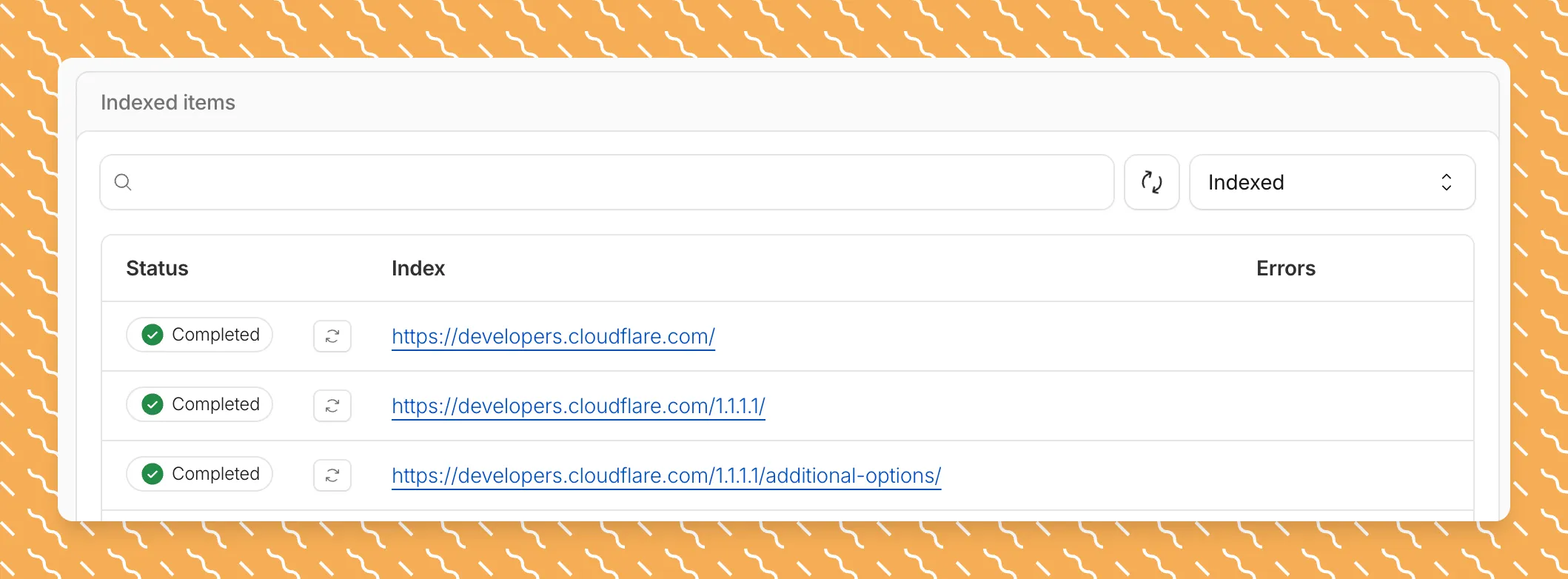
Get your content updates into AI Search faster and avoid a full rescan when you do not need it.
Reindex individual files without a full sync
Updated a file or need to retry one that errored? When you know exactly which file changed, you can now reindex it directly instead of rescanning your entire data source.
Go to Overview > Indexed Items and select the sync icon next to any file to reindex it immediately.
Crawl only the sitemap you need
By default, AI Search crawls all sitemaps listed in your robots.txt, up to the maximum files per index limit. If your site has multiple sitemaps but you only want to index a specific set, you can now specify a single sitemap URL to limit what the crawler visits.
For example, if your robots.txt lists both blog-sitemap.xml and docs-sitemap.xml, you can specify just https://example.com/docs-sitemap.xml to index only your documentation.
Configure your selection anytime in Settings > Parsing options > Specific sitemaps, then trigger a sync to apply the changes.
R2 SQL now supports five approximate aggregation functions for fast analysis of large datasets. These functions trade minor precision for improved performance on high-cardinality data.
New functions
APPROX_PERCENTILE_CONT(column, percentile) — Returns the approximate value at a given percentile (0.0 to 1.0). Works on integer and decimal columns.
APPROX_PERCENTILE_CONT_WITH_WEIGHT(column, weight, percentile) — Weighted percentile calculation where each row contributes proportionally to its weight column value.
APPROX_MEDIAN(column) — Returns the approximate median. Equivalent to APPROX_PERCENTILE_CONT(column, 0.5).
APPROX_DISTINCT(column) — Returns the approximate number of distinct values. Works on any column type.
APPROX_TOP_K(column, k) — Returns the k most frequent values with their counts as a JSON array.
All functions support WHERE filters. All except APPROX_TOP_K support GROUP BY.
-- Median per departmentSELECT department, approx_median(total_amount)FROM my_namespace.sales_dataGROUP BY department
-- Approximate distinct customers by regionSELECT region, approx_distinct(customer_id)FROM my_namespace.sales_dataGROUP BY region
-- Top 5 most frequent departmentsSELECT approx_top_k(department, 5)FROM my_namespace.sales_data
-- Combine approximate and standard aggregationsSELECT COUNT(*), AVG(total_amount), approx_percentile_cont(total_amount, 0.5), approx_distinct(customer_id)FROM my_namespace.sales_dataWHERE region = 'North'
For the full syntax and additional examples, refer to the SQL reference.
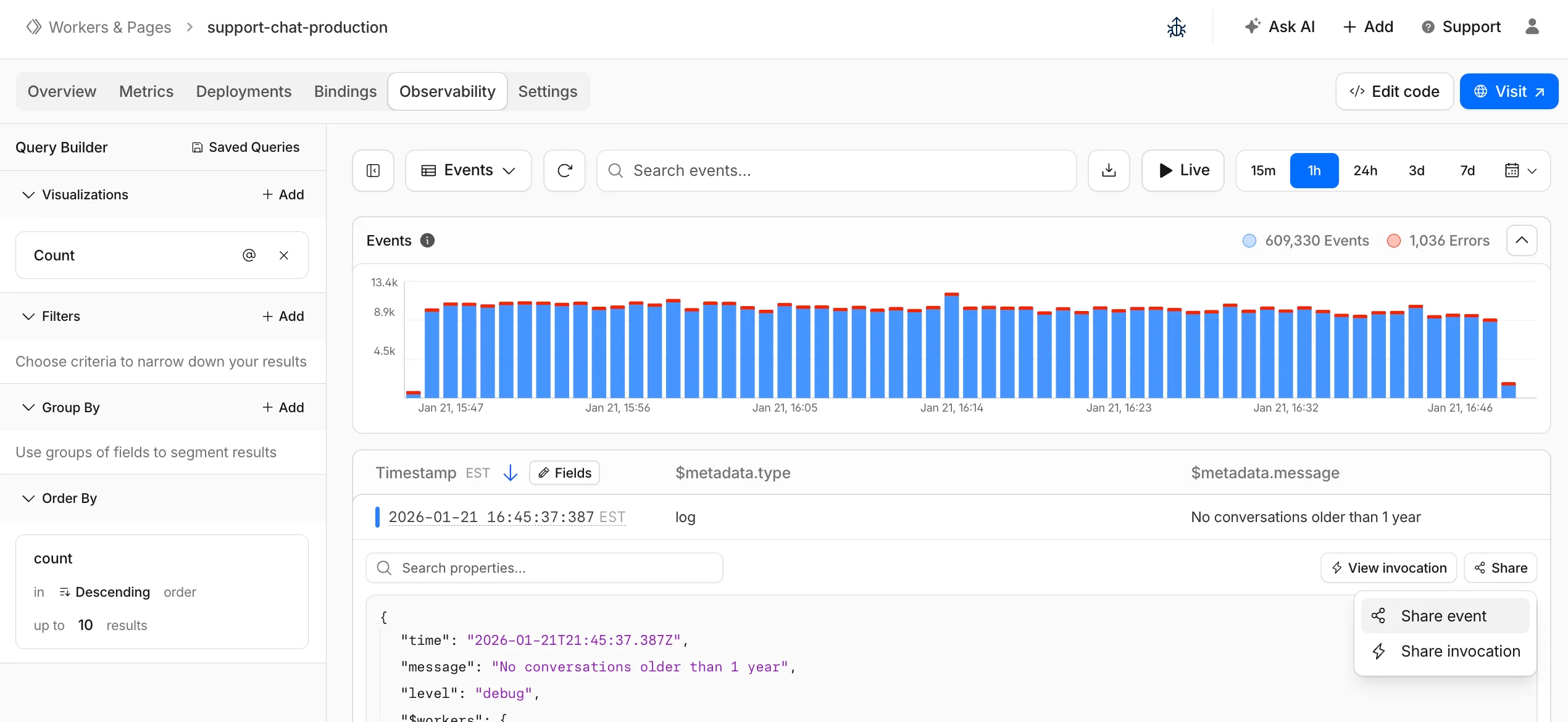
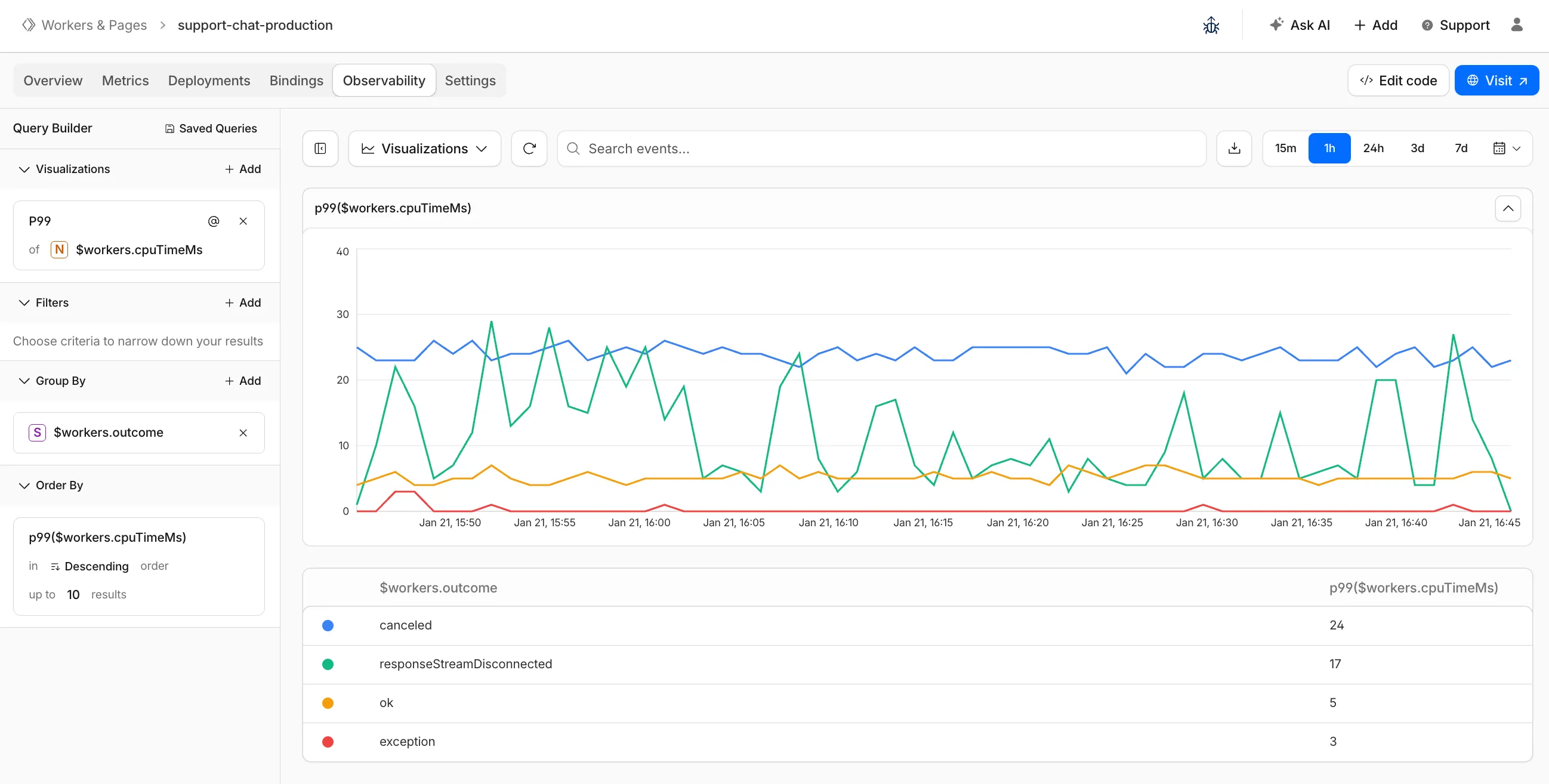
The Workers Observability dashboard ↗ has some major updates to make it easier to debug your application's issues and share findings with your team.
You can now:
Create visualizations — Build charts from your Worker data directly in a Worker's Observability tab
Export data as JSON or CSV — Download logs and traces for offline analysis or to share with teammates
Share events and traces — Generate direct URLs to specific events, invocations, and traces that open standalone pages with full context
Customize table columns — Improved field picker to add, remove, and reorder columns in the events table
Expandable event details — Expand events inline to view full details without leaving the table
Keyboard shortcuts — Navigate the dashboard with hotkey support
These updates are now live in the Cloudflare dashboard, both in a Worker's Observability tab and in the account-level Observability dashboard for a unified experience. To get started, go to Workers & Pages > select your Worker > Observability.
Cloudflare Queues is now part of the Workers free plan, offering guaranteed message delivery across up to 10,000 queues to either Cloudflare Workers or HTTP pull consumers. Every Cloudflare account now includes 10,000 operations per day across reads, writes, and deletes. For more details on how each operation is defined, refer to Queues pricing ↗.
All features of the existing Queues functionality are available on the free plan, including unlimited event subscriptions. Note that the maximum retention period on the free tier, however, is 24 hours rather than 14 days.
If you are new to Cloudflare Queues, follow this guide ↗ or try one of our tutorials to get started.
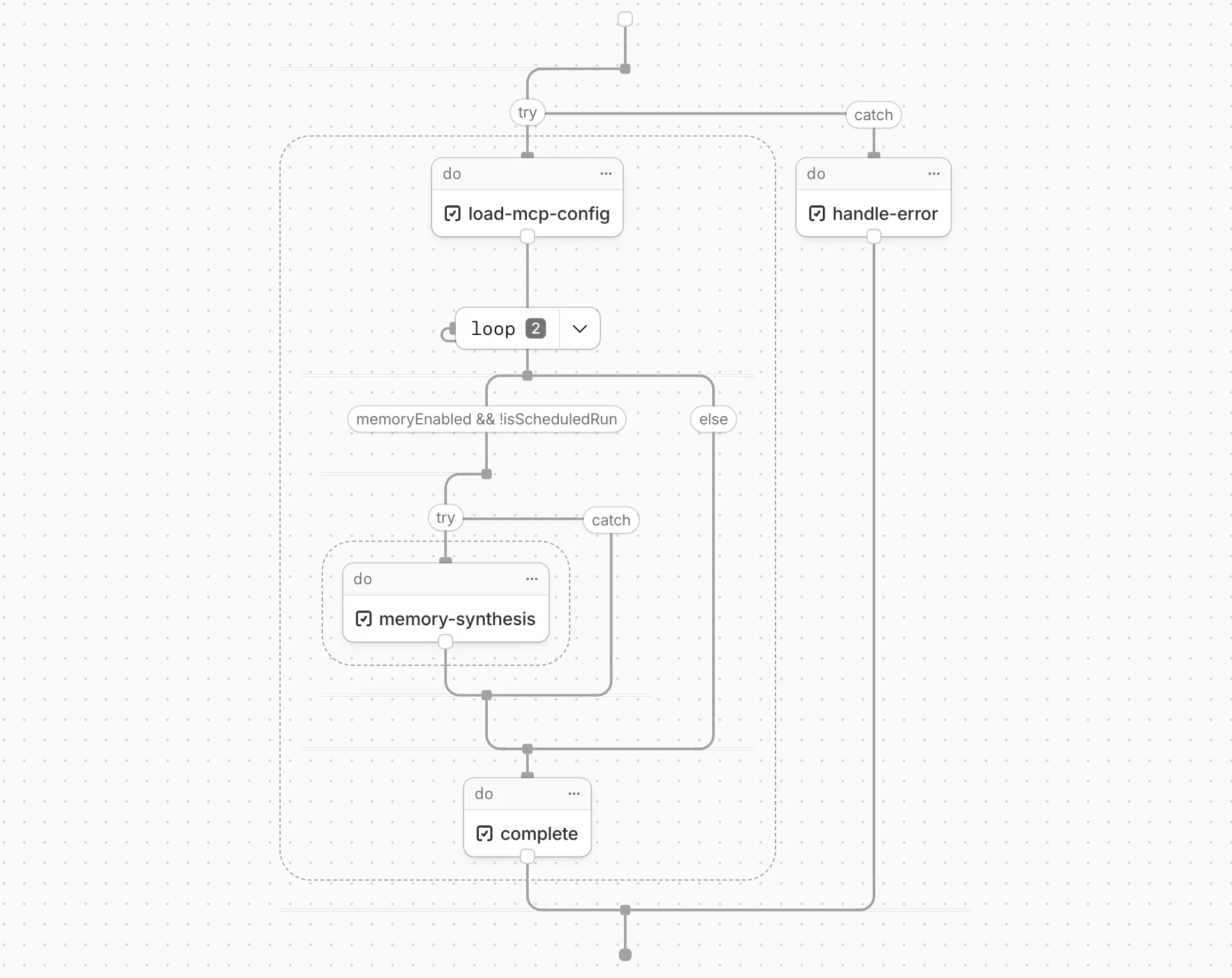
Cloudflare Workflows now automatically generates visual diagrams from your code
Your Workflow is parsed to provide a visual map of the Workflow structure, allowing you to:
Understand how steps connect and execute
Visualize loops and nested logic
Follow branching paths for conditional logic
You can collapse loops and nested logic to see the high-level flow, or expand them to see every step.
Workflow diagrams are available in beta for all JavaScript and TypeScript Workflows. Find your Workflows in the Cloudflare dashboard ↗ to see their diagrams.
The latest release of the Agents SDK ↗ brings first-class support for Cloudflare Workflows, synchronous state management, and new scheduling capabilities.
Cloudflare Workflows integration
Agents excel at real-time communication and state management. Workflows excel at durable execution. Together, they enable powerful patterns where Agents handle WebSocket connections while Workflows handle long-running tasks, retries, and human-in-the-loop flows.
Use the new AgentWorkflow class to define workflows with typed access to your Agent:
Secure email reply routing — Email replies are now secured with HMAC-SHA256 signed headers, preventing unauthorized routing of emails to agent instances.
Routing improvements:
basePath option to bypass default URL construction for custom routing
Server-sent identity — Agents send name and agent type on connect
New onIdentity and onIdentityChange callbacks on the client
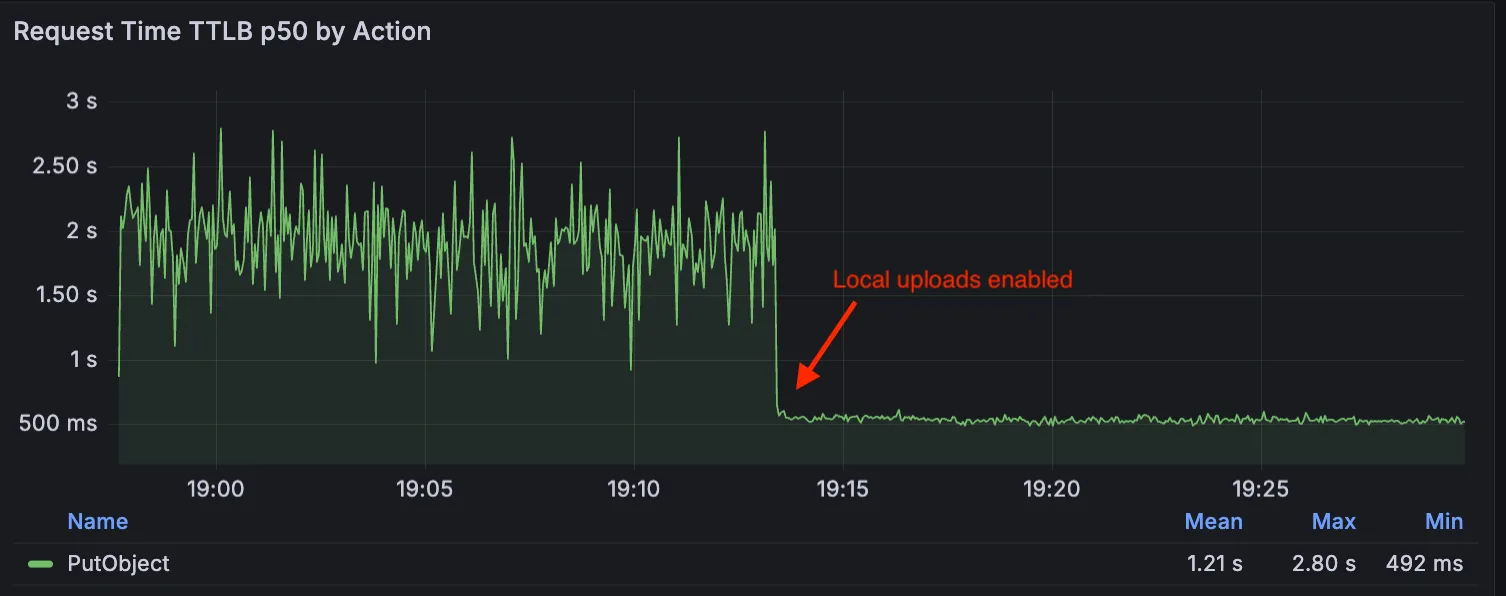
Local Uploads is now available in open beta. Enable it on your R2 bucket to improve upload performance when clients upload data from a different region than your bucket. With Local Uploads enabled, object data is written to storage infrastructure near the client, then asynchronously replicated to your bucket. The object is immediately accessible and remains strongly consistent throughout. Refer to How R2 works for details on how data is written to your bucket.
In our tests, we observed up to 75% reduction in Time to Last Byte (TTLB) for upload requests when Local Uploads is enabled.
This feature is ideal when:
Your users are globally distributed
Upload performance and reliability is critical to your application
You want to optimize write performance without changing your bucket's primary location
To enable Local Uploads on your bucket, find Local Uploads in your bucket settings in the Cloudflare Dashboard ↗, or run:
Enabling Local Uploads on a bucket is seamless: existing uploads will complete as expected and there’s no interruption to traffic. There is no additional cost to enable Local Uploads. Upload requests incur the standard Class A operation costs same as upload requests made without Local Uploads.
The minimum cacheTtl parameter for Workers KV has been reduced from 60 seconds to 30 seconds. This change applies to both get() and getWithMetadata() methods.
This reduction allows you to maintain more up-to-date cached data and have finer-grained control over cache behavior. Applications requiring faster data refresh rates can now configure cache durations as low as 30 seconds instead of the previous 60-second minimum.
The cacheTtl parameter defines how long a KV result is cached at the global network location it is accessed from:
// Read with custom cache TTLconst value = await env.NAMESPACE.get("my-key", { cacheTtl: 30, // Cache for minimum 30 seconds (previously 60)});// getWithMetadata also supports the reduced cache TTLconst valueWithMetadata = await env.NAMESPACE.getWithMetadata("my-key", { cacheTtl: 30, // Cache for minimum 30 seconds});
The default cache TTL remains unchanged at 60 seconds. Upgrade to the latest version of Wrangler to be able to use 30 seconds cacheTtl.
We have partnered with Black Forest Labs (BFL) again to bring their optimized FLUX.2 [klein] 9B model to Workers AI. This distilled model offers enhanced quality compared to the 4B variant, while maintaining cost-effective pricing. With a fixed 4-step inference process, Klein 9B is ideal for rapid prototyping and real-time applications where both speed and quality matter.
The model hosted on Workers AI is optimized for speed with a fixed 4-step inference process and supports up to 4 image inputs. Since this is a distilled model, the steps parameter is fixed at 4 and cannot be adjusted. Like FLUX.2 [dev] and FLUX.2 [klein] 4B, this image model uses multipart form data inputs, even if you just have a prompt.
With the REST API, the multipart form data input looks like this:
curl --request POST \
  --url 'https://api.cloudflare.com/client/v4/accounts/{ACCOUNT}/ai/run/@cf/black-forest-labs/flux-2-klein-9b' \
  --header 'Authorization: Bearer {TOKEN}' \
  --header 'Content-Type: multipart/form-data' \
  --form 'prompt=a sunset at the alps' \
  --form width=1024 \
  --form height=1024
With the Workers AI binding, you can use it as such:
const form = new FormData();form.append("prompt", "a sunset with a dog");form.append("width", "1024");form.append("height", "1024");// FormData doesn't expose its serialized body or boundary. Passing it to a// Request (or Response) constructor serializes it and generates the Content-Type// header with the boundary, which is required for the server to parse the multipart fields.const formResponse = new Response(form);const formStream = formResponse.body;const formContentType = formResponse.headers.get('content-type');const resp = await env.AI.run("@cf/black-forest-labs/flux-2-klein-9b", { multipart: { body: formStream, contentType: formContentType, },});
The parameters you can send to the model are detailed here:
JSON Schema for ModelRequired Parameters
prompt (string) - Text description of the image to generate
Optional Parameters
input_image_0 (string) - Binary image
input_image_1 (string) - Binary image
input_image_2 (string) - Binary image
input_image_3 (string) - Binary image
guidance (float) - Guidance scale for generation. Higher values follow the prompt more closely
width (integer) - Width of the image, default 1024 Range: 256-1920
height (integer) - Height of the image, default 768 Range: 256-1920
seed (integer) - Seed for reproducibility
Note: Since this is a distilled model, the steps parameter is fixed at 4 and cannot be adjusted.
Multi-reference images
The FLUX.2 klein-9b model supports generating images based on reference images, just like FLUX.2 [dev] and FLUX.2 [klein] 4B. You can use this feature to apply the style of one image to another, add a new character to an image, or iterate on past generated images. You would use it with the same multipart form data structure, with the input images in binary. The model supports up to 4 input images.
For the prompt, you can reference the images based on the index, like take the subject of image 1 and style it like image 0 or even use natural language like place the dog beside the woman.
You must name the input parameter as input_image_0, input_image_1, input_image_2, input_image_3 for it to work correctly. All input images must be smaller than 512x512.
curl --request POST \
  --url 'https://api.cloudflare.com/client/v4/accounts/{ACCOUNT}/ai/run/@cf/black-forest-labs/flux-2-klein-9b' \
  --header 'Authorization: Bearer {TOKEN}' \
  --header 'Content-Type: multipart/form-data' \
  --form 'prompt=take the subject of image 1 and style it like image 0' \
  --form input_image_0=@/Users/johndoe/Desktop/icedoutkeanu.png \
  --form input_image_1=@/Users/johndoe/Desktop/me.png \
  --form width=1024 \
  --form height=1024
Through Workers AI Binding:
//helper function to convert ReadableStream to Blobasync function streamToBlob(stream: ReadableStream, contentType: string): Promise<Blob> { const reader = stream.getReader(); const chunks = []; while (true) { const { done, value } = await reader.read(); if (done) break; chunks.push(value); } return new Blob(chunks, { type: contentType });}const image0 = await fetch("http://image-url");const image1 = await fetch("http://image-url");const form = new FormData();const image_blob0 = await streamToBlob(image0.body, "image/png");const image_blob1 = await streamToBlob(image1.body, "image/png");form.append('input_image_0', image_blob0)form.append('input_image_1', image_blob1)form.append('prompt', 'take the subject of image 1 and style it like image 0')// FormData doesn't expose its serialized body or boundary. Passing it to a// Request (or Response) constructor serializes it and generates the Content-Type// header with the boundary, which is required for the server to parse the multipart fields.const formResponse = new Response(form);const formStream = formResponse.body;const formContentType = formResponse.headers.get('content-type');const resp = await env.AI.run("@cf/black-forest-labs/flux-2-klein-9b", { multipart: { body: formStream, contentType: formContentType }})
You can now store up to 10 million vectors in a single Vectorize index, doubling the previous limit of 5 million vectors. This enables larger-scale semantic search, recommendation systems, and retrieval-augmented generation (RAG) applications without splitting data across multiple indexes.
Vectorize continues to support indexes with up to 1,536 dimensions per vector at 32-bit precision. Refer to the Vectorize limits documentation for complete details.
You can now configure Workers to run close to infrastructure in legacy cloud regions to minimize latency to existing services and databases. This is most useful when your Worker makes multiple round trips.
To set a placement hint, set the placement.region property in your Wrangler configuration file:
{ "placement": { "region": "aws:us-east-1", },}
[placement]region = "aws:us-east-1"
Placement hints support Amazon Web Services (AWS), Google Cloud Platform (GCP), and Microsoft Azure region identifiers. Workers run in the Cloudflare data center ↗ with the lowest latency to the specified cloud region.
If your existing infrastructure is not in these cloud providers, expose it to placement probes with placement.host for layer 4 checks or placement.hostname for layer 7 checks. These probes are designed to locate single-homed infrastructure and are not suitable for anycasted or multicasted resources.
This is an extension of Smart Placement, which automatically places your Workers closer to back-end APIs based on measured latency. When you do not know the location of your back-end APIs or have multiple back-end APIs, set mode: "smart":
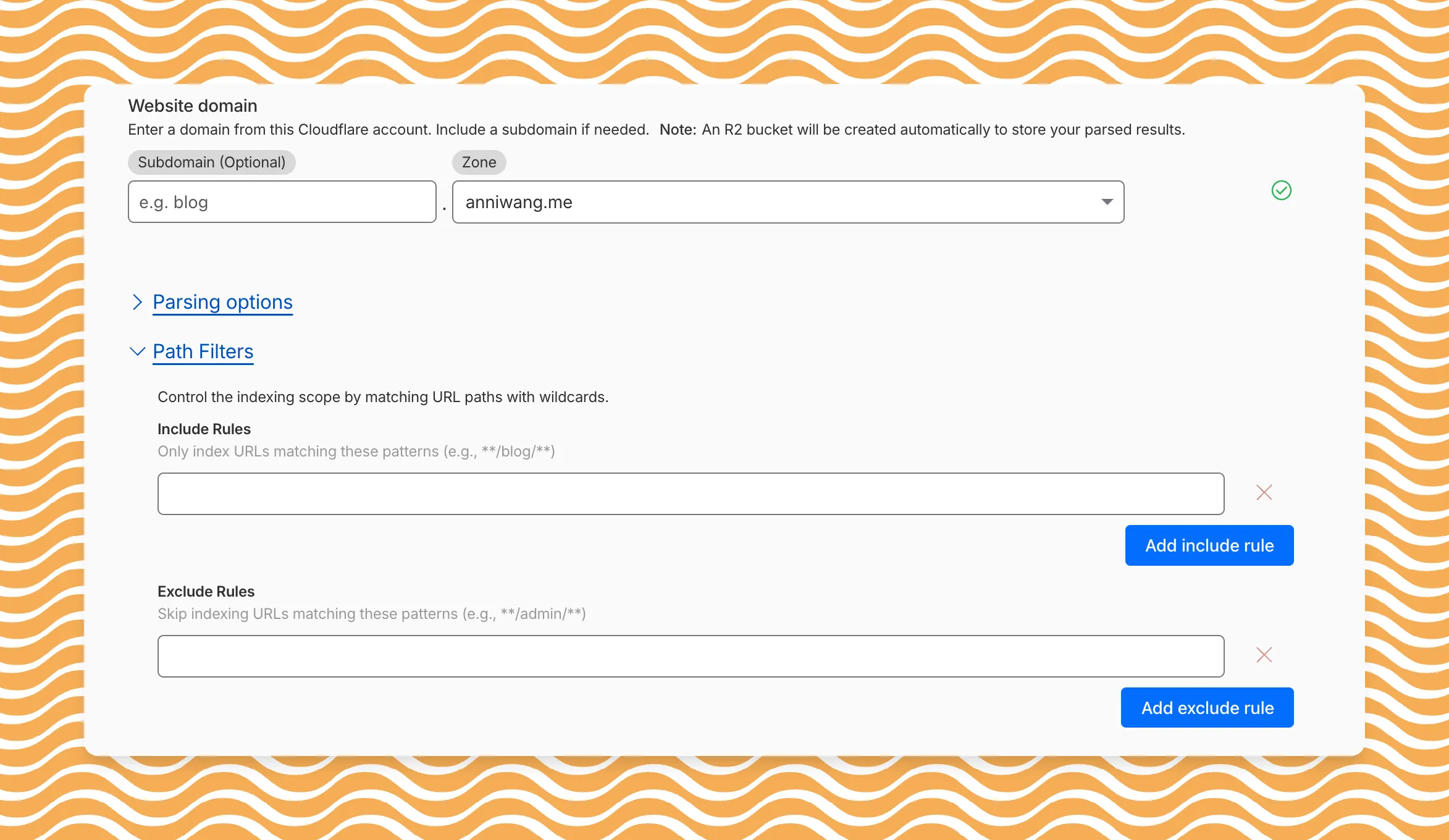
AI Search now includes path filtering for both website and R2 data sources. You can now control which content gets indexed by defining include and exclude rules for paths.
By controlling what gets indexed, you can improve the relevance and quality of your search results. You can also use path filtering to split a single data source across multiple AI Search instances for specialized search experiences.
Path filtering uses micromatch ↗ patterns, so you can use * to match within a directory and ** to match across directories.
Use case
Include
Exclude
Index docs but skip drafts
**/docs/**
**/docs/drafts/**
Keep admin pages out of results
—
**/admin/**
Index only English content
**/en/**
—
Configure path filters when creating a new instance or update them anytime from Settings. Check out path filtering to learn more.
You can now create AI Search instances programmatically using the API. For example, use the API to create instances for each customer in a multi-tenant application or manage AI Search alongside your other infrastructure.
If you have created an AI Search instance via the dashboard before, you already have a service API token registered and can start creating instances programmatically right away. If not, follow the API guide to set up your first instance.
For example, you can now create separate search instances for each language on your website:
for lang in en fr es de; do curl -X POST "https://api.cloudflare.com/client/v4/accounts/$ACCOUNT_ID/ai-search/instances" \ -H "Authorization: Bearer $API_TOKEN" \ -H "Content-Type: application/json" \ --data '{ "id": "docs-'"$lang"'", "type": "web-crawler", "source": "example.com", "source_params": { "path_include": ["**/'"$lang"'/**"] } }'done
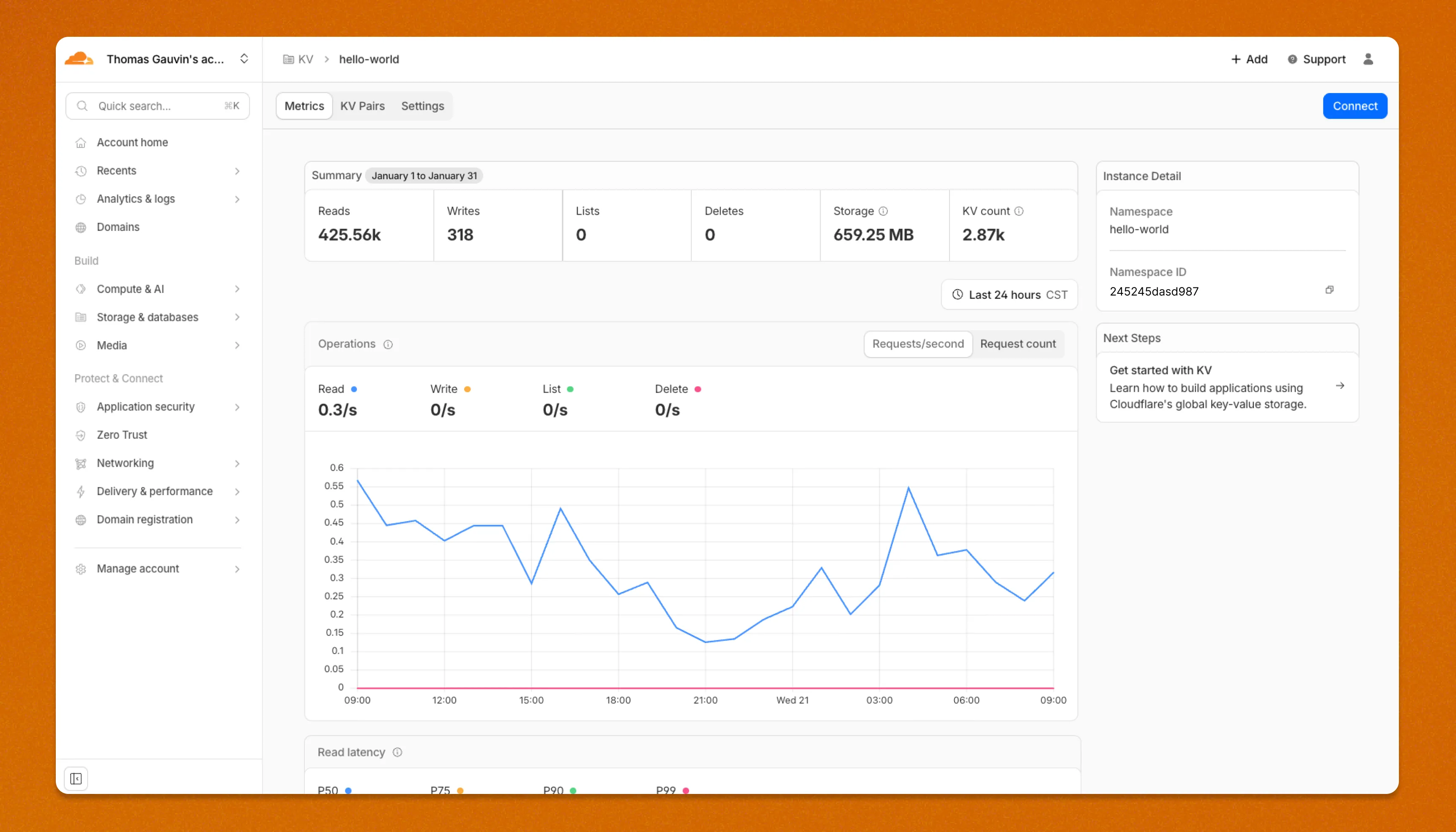
Workers KV has an updated dashboard UI with new dashboard styling that makes it easier to navigate and see analytics and settings for a KV namespace.
The new dashboard features a streamlined homepage for easy access to your namespaces and key operations, with consistent design with the rest of the dashboard UI updates. It also provides an improved analytics view.
The updated dashboard is now available for all Workers KV users. Log in to the Cloudflare Dashboard ↗ to start exploring the new interface.
In this release, you'll see a large number of breaking changes. This is primarily due to a change in OpenAPI definitions, which our libraries are based off of, and codegen updates that we rely on to read those OpenAPI definitions and produce our SDK libraries. As the codegen is always evolving and improving, so are our code bases.
Some breaking changes were introduced due to bug fixes, also listed below.
Please ensure you read through the list of changes below before moving to this version - this will help you understand any down or upstream issues it may cause to your environments.