Cloudflare now enforces DNS records quotas at the account level for Enterprise accounts. Instead of a per-zone limit, these accounts have a quota on the total number of records across all of their zones, letting you distribute records across your zones however you like — regardless of each zone's plan. Public and internal zones are counted separately, each with a default quota of 1,000,000 records.
Accounts without an account-level quota are unaffected: existing per-zone quotas behave exactly as before.
The Flagship API reference is now available. You can use the Cloudflare API to create and update apps, and to create, update, delete, and list feature flags without using the dashboard.
For example, create a new boolean flag with the API:
To create an API token, go to Account API Tokens ↗ in the Cloudflare dashboard and search for Flagship.
The API reference includes endpoints for Flagship apps, flags, changelog entries, and flag evaluation. Agents can also use the Flagship reference in the Cloudflare skill ↗ to create and manage Flagship resources.
Refer to the Flagship documentation to learn more about evaluating feature flags from your applications.
Use the Images binding to upload, list, retrieve, update, and delete images stored in Images directly from your Worker without managing API tokens or making HTTP requests.
The env.IMAGES.hosted namespace supports the following storage and management operations:
TL;DR: Brand Protection now features an Automated Cease & Desist (C&D) workflow. When you discover an infringing domain hosted outside of Cloudflare, you can instantly generate, review, and download a custom-branded, pre-filled legal notice in seconds.
Why this matters
This update introduces a major shift from pure detection to actionable enforcement, eliminating the manual burden for your Trust & Safety and Legal teams:
Instant WHOIS and Recipient Lookup: We automatically scrape registrar data and WHOIS contact information (such as the registrant or registrar abuse email) behind the scenes, highlighting exactly where your notice needs to be sent
Smart Template Automation: We pre-fill your custom-branded templates with essential metadata, including the infringing domain, registrar name, and discovery date.
Tailored Enforcement Tones: Choose from three default layout strategies depending on the severity of the infrastructure match:
Exact Match: A formal demand for identical trademark infringements
Similar Match: A standard notice optimized for typosquatting (one-character distance matches)
Friendly Tone: An amicable initial outreach for potential unintentional or accidental infringements
Full Editing Control: Before creating the final PDF, a real-time review screen allows you to fine-tune the messaging, modify placeholders, and ensure your text aligns perfectly with internal legal standards
How it works
When reviewing a malicious domain match inside your dashboard, your enforcement path splits depending on where the attacker is located:
On the Cloudflare Network: If the domain uses Cloudflare’s network or registrar, trigger our existing integrated abuse reporting flow with one click.
Hosted Elsewhere: If the domain is hosted on an external provider, click the Generate C&D Letter option to launch the new document builder, pick your template, verify the auto-populated recipient data, and download your finalized PDF.
You can manage your templates and enforce matches by going to the Cloudflare Dashboard > Application Security > Brand Protection and selecting your detected Brand Protection matches.
For more information, read the Brand Protection documentation.
Note: Cloudflare does not represent you and cannot provide you with legal advice. Only you can decide whether your rights have been infringed, whether a cease and desist letter is appropriate, and what that letter should say.
Today we are announcing the deprecation of several features from the Sandbox SDK. The SDK has grown and matured substantially since it first launched. As agent workflows have developed, we have shipped many new features and experiments so developers can easily integrate secure, isolated code execution into their workflows.
We want the SDK to continue providing a stable foundation for agentic workflows while we iterate quickly on the codebase. These deprecated features have either been superseded by newer capabilities or seen low adoption. They will remain in the codebase until July 9, 2026, after which they will no longer be present in future Sandbox SDK versions.
HTTP and WebSocket transports
In April 2026, we released the new RPC transport and deprecated the WebSocket transport. This setting governs how the sandbox container talks to the Workers ecosystem. The RPC transport removes the limitations of both the HTTP and WebSocket transports. As of June 9, 2026, it is the recommended default. HTTP and WebSocket transports will no longer be present in Sandbox SDK versions released after July 9, 2026.
To migrate before July 9, 2026, update the SANDBOX_TRANSPORT variable to rpc or set the transport option when calling getSandbox(). For more information, refer to the transport configuration documentation.
Desktop
The desktop feature landed as a technical demonstration of what can be done with the Sandbox SDK — controlling a full browser environment from within a sandbox. With Cloudflare Browser Run now available, this feature saw very little use. We have removed it in 0.10.2.
Expose ports
We recently released support for Cloudflare Tunnel in the Sandbox SDK. This provides a robust API for exposing services running in your sandbox to the public internet. It fixes issues many were facing with local development and deployment to workers.dev domains. To migrate from exposePort() to tunnels, refer to the tunnels API documentation and the expose services guide.
Default sessions
By default, the exec() method in the Sandbox SDK maintains a default session across all calls, so a cd in one call is honored in the next. This convenience helped developers writing exec statements by hand, but confused agents and caused hard-to-trace bugs. As of 0.10.3, we have introduced the enableDefaultSession flag on the getSandbox() interface to turn this off. Default sessions as a concept — and the flag — will be removed in an upcoming release.
We recommend setting enableDefaultSession: false today and using the sandbox.createSession() API when you need the previous behavior.
Other changes
We are also consolidating all APIs that buffer data to support streaming by default. This includes readFile, writeFile, and exec. The stream equivalents will be removed.
We are exploring moving non-core features like the code interpreter, terminal, and git APIs into helpers. These features will retain their existing APIs, so migration should be simple.
This release introduces new detections for a critical SQL injection vulnerability in Drupal installations utilizing PostgreSQL (CVE-2026-9082), alongside targeted protection for an unsafe deserialization flaw in the Mirasvit Cache Warmer extension (CVE-2026-45247). Additionally, this release includes coverage for a prototype pollution vector in Axios (CVE-2026-40175) and a new generic rule designed to identify and block sophisticated SQL Injection (SQLi) bypass attempts leveraging obfuscated boolean logic.
Key Findings
CVE-2026-9082: A database abstraction vulnerability affects Drupal sites configured with a PostgreSQL backend. Remote, unauthenticated attackers can exploit this flaw via crafted inputs to inject malicious SQL commands and access or manipulate backend data.
CVE-2026-45247: A PHP Object Injection vulnerability exists in the Mirasvit Cache Warmer extension for Magento and Adobe Commerce. This flaw stems from unsafe deserialization of untrusted user input, enabling unauthenticated attackers to execute arbitrary code on the hosting server.
CVE-2026-40175: A prototype pollution vulnerability affects the Axios HTTP client library. Attackers can exploit this to inject malicious properties into the global JavaScript object prototype, potentially causing application crashes (Denial of Service) or executing unauthorized code depending on the application structure.
Impact
Successful exploitation of these vulnerabilities could allow unauthenticated attackers to execute arbitrary code, manipulate database contents, or induce application crashes, leading to severe operational disruption or complete server compromise. These newly deployed signatures intercept these advanced malicious payloads at the edge before they can interact with vulnerable software configurations.
Ruleset
Rule ID
Legacy Rule ID
Description
Previous Action
New Action
Comments
Cloudflare Managed Ruleset
N/A
Axios - Prototype Pollution - CVE:CVE-2026-40175
Log
Block
This is a new detection.
Cloudflare Managed Ruleset
N/A
Drupal - PostgreSQL SQLi - CVE:CVE-2026-9082 - Body
Log
Block
This is a new detection.
Cloudflare Managed Ruleset
N/A
Drupal - PostgreSQL SQLi - CVE:CVE-2026-9082 - URI
You can now send emails through Cloudflare Email Service using authenticated SMTP submission on smtp.mx.cloudflare.net:465. SMTP joins the REST API and the Workers binding as a third way to send transactional email — useful for existing applications that already speak SMTP and language-native SMTP libraries (Nodemailer, smtplib, PHPMailer, JavaMail).
Setting
Value
Host
smtp.mx.cloudflare.net
Port
465 (implicit TLS)
AUTH
PLAIN or LOGIN
Username
api_token
Password
A Cloudflare API token (account-owned or user-owned) with Email Sending: Edit
Submissions enter the same delivery pipeline as the REST API and Workers binding: identical limits, automatic DKIM and ARC signing, and shared dashboard logs.
R2 SQL now supports set operations (UNION, INTERSECT, EXCEPT) and SELECT DISTINCT, expanding the range of analytical queries you can run directly on Apache Iceberg ↗ tables in R2 Data Catalog.
Set operations
Combine the results of multiple SELECT statements:
UNION — returns all rows from both queries, removing duplicates
UNION ALL — returns all rows from both queries, including duplicates
INTERSECT — returns only rows that appear in both queries
EXCEPT — returns rows from the first query that do not appear in the second
-- Find zones that had either firewall blocks OR high-risk requestsSELECT zone_id FROM my_namespace.firewall_events WHERE action = 'block'UNIONSELECT zone_id FROM my_namespace.http_requests WHERE risk_score > 0.8
-- Find zones with both firewall blocks AND high trafficSELECT zone_id FROM my_namespace.firewall_events WHERE action = 'block'INTERSECTSELECT zone_id FROM my_namespace.http_requestsGROUP BY zone_idHAVING COUNT(*) > 10000
-- Find enterprise zones that have not been compactedSELECT zone_id FROM my_namespace.zones WHERE plan = 'enterprise'EXCEPTSELECT zone_id FROM my_namespace.compaction_history
RealtimeKit lets you build products where people meet over live audio and video — such as HealthTech, EdTech, proctoring, and other real-time platforms — on Cloudflare's global WebRTC infrastructure.
Post-meeting transcription is now Generally Available, so completed RealtimeKit meetings can automatically produce full transcript files after they end. Those transcripts can also power AI-generated summaries for meeting notes, review workflows, and follow-up tasks after the transcript is available.
Post-meeting transcription is a managed service powered by Workers AI using Whisper Large v3 Turbo. RealtimeKit handles transcription processing and can return transcript and summary files through webhooks or the REST API, so you do not need to run your own transcription infrastructure.
Generate transcripts and summaries
To generate a transcript after a meeting ends, set transcribe_on_end: true when creating a meeting. To also generate an AI summary automatically after the transcript is available, set summarize_on_end: true:
When RealtimeKit finishes processing a meeting, it creates download URLs for the transcript and, if summarize_on_end is set, the summary. You can receive those URLs automatically with webhooks, or fetch them later for a specific session with the REST API.
To receive results as soon as they are ready, configure the meeting.transcript and meeting.summary webhook events:
Cloudforce One users can now turn Threat Events indicators into active defense. With this update, users can instantly generate a WAF rule that matches the dynamic list of IP addresses returned by any of their Saved Views.
Why this matters
Threat intelligence is most effective when it is immediately actionable. Previously, blocking threat actors required manually extracting indicators from threat events and copying them into your firewall rules.
This new integration bridges the gap between threat discovery and threat mitigation:
When you identify an active threat pattern - such as an ongoing campaign targeting a specific industry, or using a known indicator type - you can pivot from investigation to mitigation in a single click.
Instead of writing complex, static IP rules, this functionality allows you to leverage the specific filtering logic you have already defined and saved within your Threat Events ecosystem.
Automating the generation of the WAF rule expression from your threat views eliminates manual copying errors, ensuring that the right malicious infrastructure is blocked instantly.
How to use it
You can implement these rules through both the dashboard UI and via the API / Terraform.
Go to Cloudflare Dashboard > Application Security > Threat Intelligence > Manage Views, select your desired view, and select Create WAF Rule.
This will automatically pre-populate the WAF rule builder with the matching threat event IP indicators.
TL;DR: We’ve launched Threat Actor Profiles directly inside the Threat Events dashboard. You can now immediately pivot from a generic alert or blocked event to a profile that unmasks the "Who, Why, and How" behind a threat event.
Why this matters
Security teams often suffer from a visibility gap. When an attack is blocked, it's difficult to know if it was a random automated bot or a sophisticated advanced persistent threat (APT) campaign specifically targeting your industry. Finding out usually means leaving your security dashboard to hunt through external OSINT feeds or static, out-of-date threat reports.
Threat Actor Profiles solve this by sharing Cloudforce One’s deep adversary research directly inside your workflow:
Cloudflare sees the traffic in real-time across approximately 20% of the web. This means actor profiles display active malicious infrastructure the moment it touches our global edge.
Every profile provides clear strategic and tactical modules including alternative aliases, origin tracking, historical threat event volume, and MITRE ATT&CK mapping detailing the adversary's technical methods.
You can search the dedicated threat actor directory or click an actor's name inside any threat event to view all details and related events to the specific threat actor.
How to use it
Adversary tracking is now available in the Cloudflare Dashbboard and ready to be included in your daily investigation workflow:
Click on the Threat Actor name in the Threat Events table to open their full identity profile and review their aliases and attack stats.
Navigate to Cloudflare Dashboard > Application Security > Threat Intelligence to explore the new Threat Actors tab. Here, you can browse a card-based directory of all established entities tracked by Cloudforce One.
Workflows now supports saga-style rollbacks, allowing you to add compensating logic to each step.do() in case of downstream failures. If the instance fails, the rollback handlers will execute in reverse step-start order.
This is useful for multi-step operations that touch external systems, such as inventory reservations, payment authorization, ticket creation, or infrastructure provisioning. Instead of writing all cleanup logic in a top-level catch, you can keep each compensating action next to the step it undoes.
Rollback handlers support their own retry and timeout configuration, and Workflows now exposes rollback outcomes in instance status responses. Workflows analytics also emits rollback lifecycle events, making it easier to distinguish a forward execution failure from a rollback failure when debugging production workflows.
AI Gateway now supports spend limits — cost-based budgets that track cumulative dollar spend and block requests when the budget is exceeded. Unlike rate limiting, which caps the number of requests, spend limits track actual cost based on token usage and model pricing.
You can scope limits by model, provider, or custom metadata dimensions. For example, give each user a 200/day budget, cap total gateway spend at 10,000/day, or limit a specific model to $50/day per user. Each rule uses a configurable time window with fixed or sliding enforcement.
Spend limits work with both Unified Billing and BYOK requests for models with known pricing.
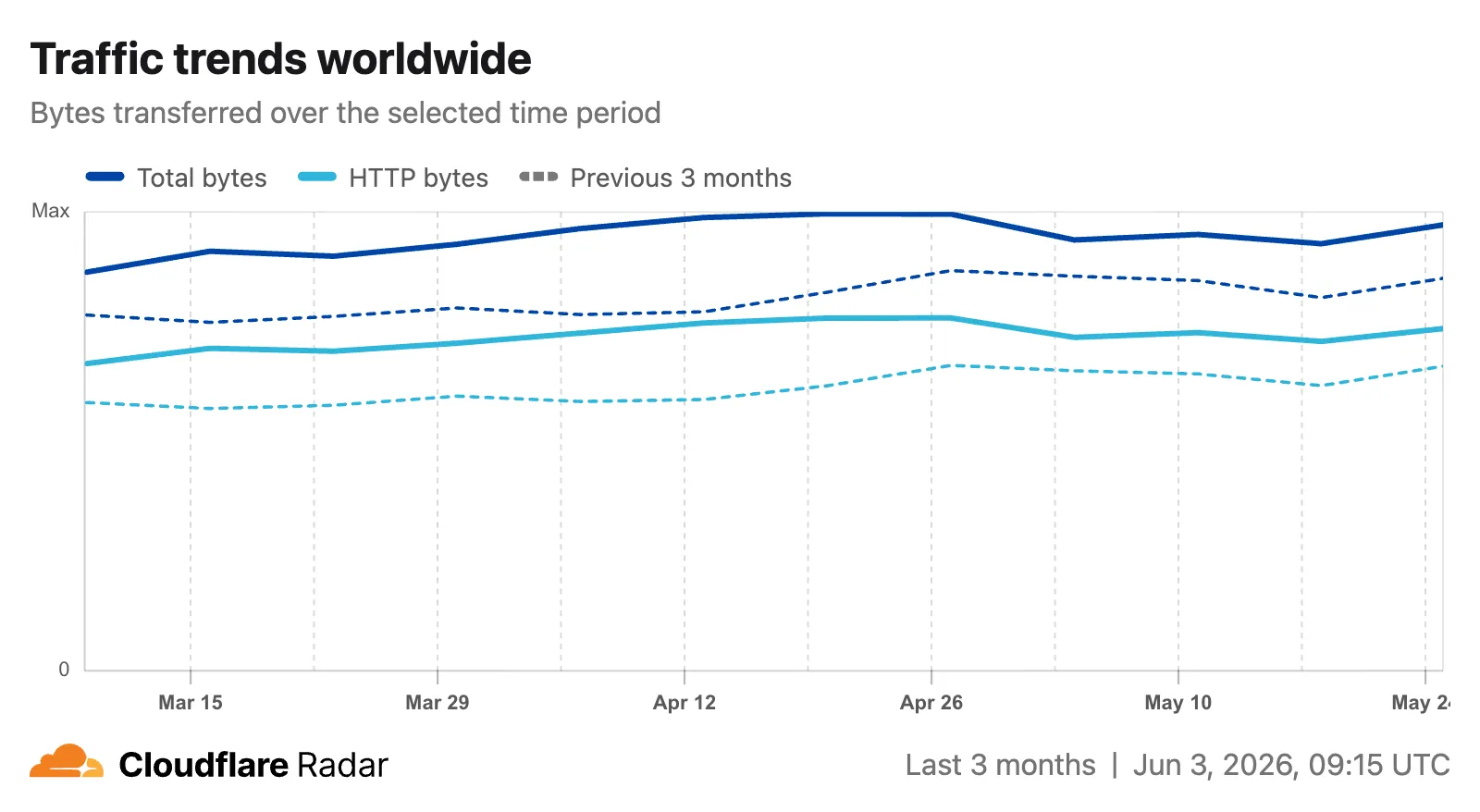
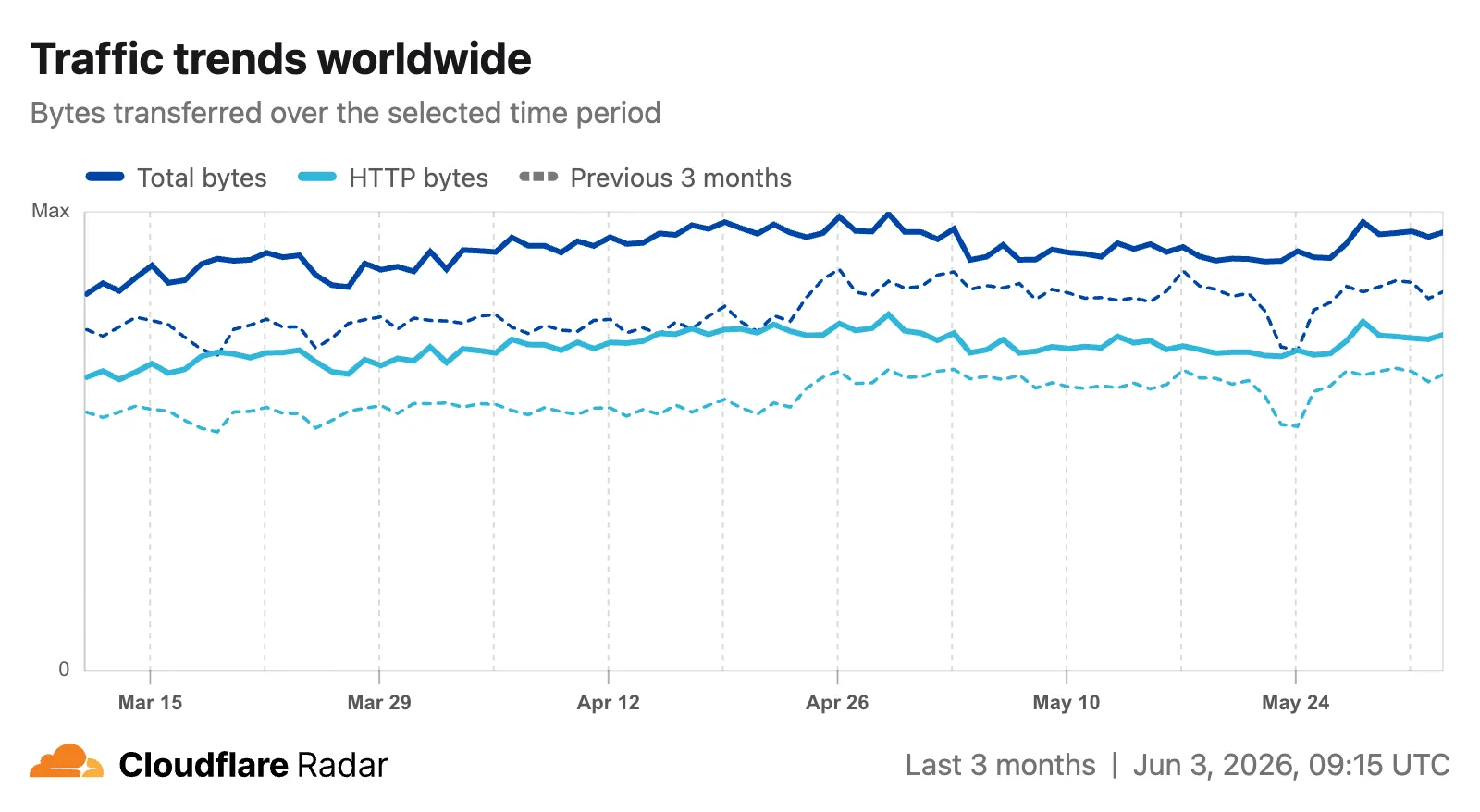
Radar now provides finer-grained traffic charts for longer time ranges. Previously, selecting a 1-3 month view on HTTP and NetFlows charts defaulted to weekly aggregation, which was too coarse to surface meaningful trends. Views longer than 3 months defaulted to monthly aggregation, returning as few as 7 data points for a 6-month range.
The new defaults are:
1-3 months: daily granularity (7x more data points)
Longer than 3 months (HTTP and NetFlows): weekly granularity (4x more data points)
For example, a 12-week traffic view previously showed weekly data:
The same view now shows daily data:
Similarly, a 1-year HTTP traffic view that previously showed just 12 monthly data points now provides 52 weekly data points.
Workers using a VPC Network binding with network_id: "cf1:network" now egress to public Internet destinations through Cloudflare Gateway. This means your existing Zero Trust traffic policies — DNS, HTTP, Network, and egress — extend to traffic that originates from your Workers, the same way they do for WARP users today.
Visibility. Worker egress shows up in Gateway DNS, HTTP, and Network logs alongside your other traffic, so you can audit what your Workers are calling and when.
Enforcement. Any existing Gateway policy whose selectors match a Worker request will apply — including allow / block lists, DNS category filtering, and HTTP destination rules. If you have already blocked a category for your workforce, your Workers inherit that block.
// Egress to a public destination — subject to your Gateway policies and loggedconst response = await env.EGRESS.fetch("https://api.example.com/data");
// Egress to a public destination — subject to your Gateway policies and loggedconst response = await env.EGRESS.fetch("https://api.example.com/data");
Cloudflare Access now supports IdP federation, which allows organizations to share a single identity provider across multiple Cloudflare accounts.
Instead of configuring the same IdP (for example, Okta or Entra ID) separately in every account, you configure it once in a source account and share it with the other accounts in your organization. Each recipient account gets a read-only IdP connection that routes authentication back to the source account through a bridge — a hidden application in the source account that brokers the cross-account login. End users sign in with their existing IdP credentials, and each account's Access policies evaluate the resulting identity just like any other IdP login.
Key capabilities:
One IdP, many accounts — Configure your IdP once and share it with all accounts in your organization.
Lifecycle management — As accounts join or leave your Cloudflare organization, their IdP connections are provisioned and removed automatically — no manual cleanup required.
Immutable recipient connections — IdP connections in recipient accounts cannot be accidentally modified or deleted.
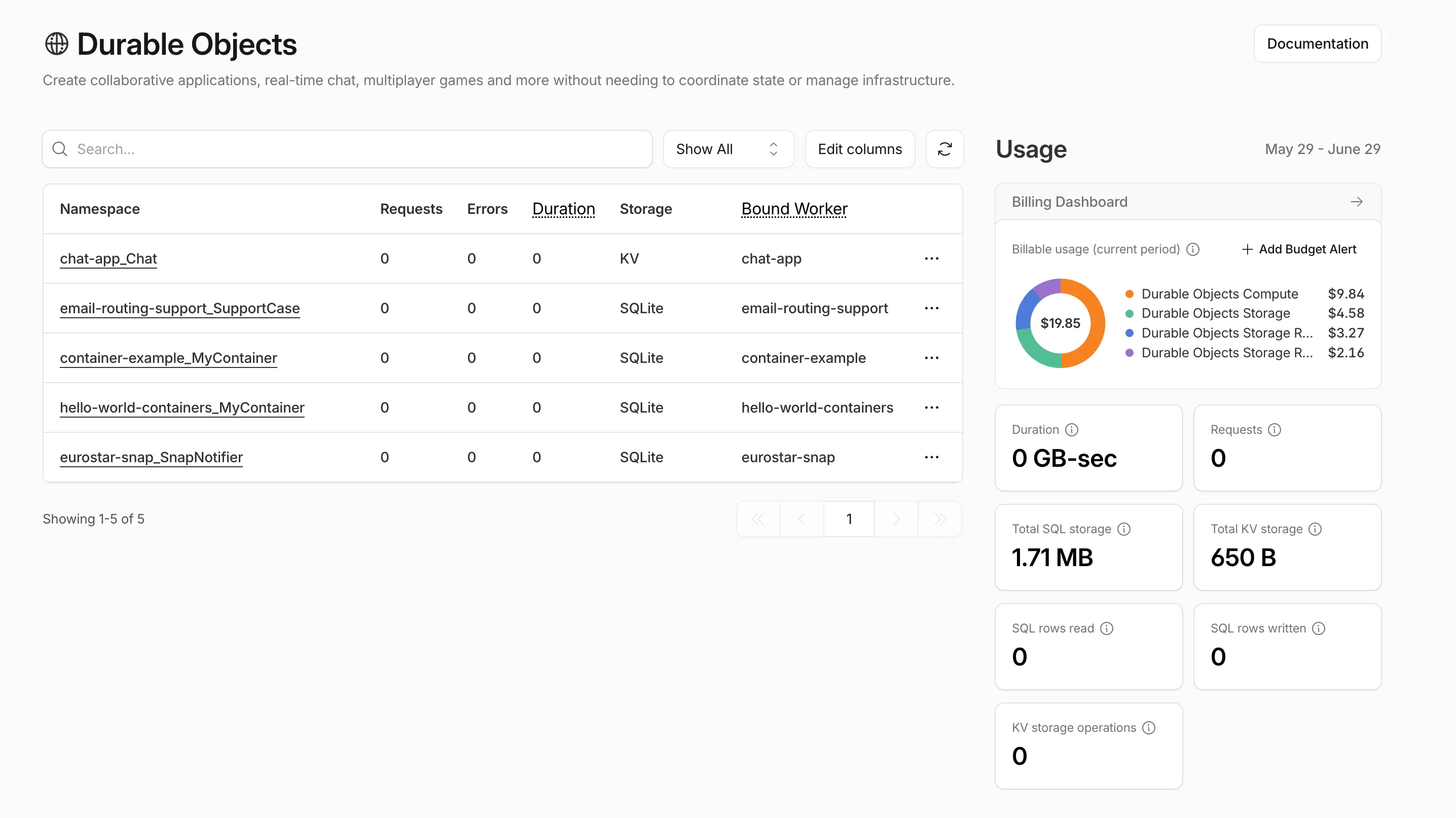
Pay-as-you-go customers can now view billable usage and create budget alerts directly from the product overview pages for Workers & Pages, D1, R2, Workers KV, Queues, Vectorize, Durable Objects, and Containers. A new sidebar widget shows current-period spend and the billing cycle date range, alongside a button to create a budget alert.
The widget pulls from the same data as the Billable Usage dashboard and aligns to your billing cycle (or the current day on Free plans), so the numbers match your invoice. Enterprise contract accounts are not yet supported.
Selecting Create budget alert opens the budget alert flow inline so you can set a dollar threshold in the same place you are reviewing usage. Budget alerts apply to your total account-level spend across all products, not just the product page you create them from.
The pipeline field inside the pipelines binding configuration in your Wrangler configuration file has been renamed to stream. The old field is deprecated but still accepted.
Update your configuration to use stream to avoid the deprecation warning.
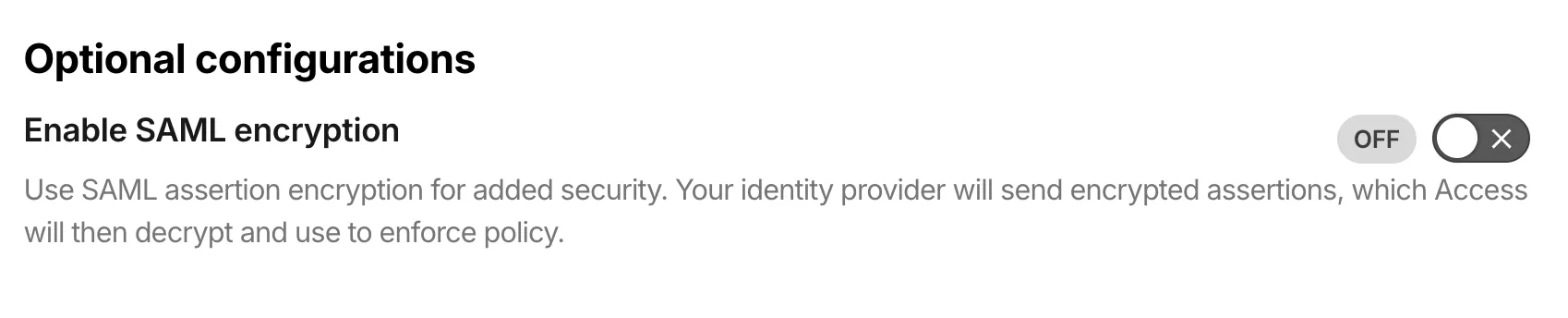
Cloudflare Access now supports SAML assertion encryption for identity provider integrations. When turned on, your identity provider encrypts SAML assertions using a Cloudflare-managed certificate before sending them through the user's browser. Only Access can decrypt these assertions, protecting sensitive identity data even after TLS termination.
Without encryption, SAML assertions are transmitted in plaintext and could be visible to browser extensions or client-side malware.
SAML encryption includes built-in certificate lifecycle management:
Automatic certificate generation: Access generates an encryption certificate when you turn on SAML encryption for an identity provider.
Certificate rotation: Rotate certificates without downtime. The previous certificate remains valid until expiration, giving you time to update your IdP.
PEM export: Copy the certificate in PEM format for manual upload to your IdP, or point your IdP to the SAML metadata endpoint for automatic retrieval.
Today we are launching self-managed OAuth, enabling developers to build third-party applications that integrate with Cloudflare via OAuth. This provides a more secure, user-friendly, and manageable alternative to API tokens.
OAuth lets third-party applications act on behalf of a user to access their Cloudflare account. For example, after a user grants consent, Wrangler can deploy Workers into that account.
What is new
Cloudflare Developers can now create and manage their own OAuth applications to integrate with Cloudflare.
Create an application
To create an application, go to Manage account > OAuth clients in your account on the Cloudflare dashboard.
If you have used an API token to call Cloudflare APIs, OAuth client scopes will look familiar. Select only the scopes your application needs during application creation, and include that scope list when sending users to Cloudflare for consent.
Users can review the requested scopes before they consent.
Apps for both private and public use
Applications start with private visibility. Private applications can only be used by members of the account where the application was created.
To make an application available to any Cloudflare user, complete the prerequisites for public visibility.
Before an application can be made public, you must verify the client domain. Domain verification helps users confirm that the application owner controls the domain shown on the consent page.
After verification, users see a verified badge on the consent page.
Wrangler can now store the OAuth credentials returned by wrangler login in an AES-256-GCM ↗-encrypted file, with the encryption key held in your operating system keychain. The default behavior is unchanged — credentials still live in a plaintext TOML file unless you opt in.
To opt in, run:
npx wrangler login --use-keyring
The choice is persisted across Wrangler invocations. Opt back out with npx wrangler login --no-use-keyring, or override the preference for a single command with the CLOUDFLARE_AUTH_USE_KEYRING environment variable.
wrangler whoami now reports where credentials are stored:
🔐 Credentials are stored in: Encrypted file (~/.config/.wrangler/config/default.enc) with key in macOS Keychain (service=wrangler, account=default)
Per-platform backends:
macOS uses the built-in Keychain via /usr/bin/security.
Linux uses libsecret ↗ via the secret-tool CLI from the libsecret-tools package.
Windows uses Credential Manager via @napi-rs/keyring ↗, installed on-demand the first time you opt in.
Refer to Storing OAuth credentials in the OS keychain for the full details, including the migration behavior on opt-in/opt-out and the CLOUDFLARE_AUTH_USE_KEYRING environment variable.
You can now attach cron schedules directly to a Workflow binding in wrangler.jsonc. Each scheduled run creates a new Workflow instance automatically, so you do not need to define a separate Worker with a scheduled handler just to trigger your Workflow on an interval.
For example, you can configure hourly, every-15-minute, or weekday schedules on the same Workflow:
Cron workloads get all the same benefits of Workflows with built-in retries, multi-step durable execution, and configurable timeouts of Workflows.
import { WorkflowEntrypoint, WorkflowEvent, WorkflowStep,} from "cloudflare:workers";// Runs automatically on each cron schedule defined for the MY_WORKFLOW binding in wrangler.jsonc.export class MyScheduledWorkflow extends WorkflowEntrypoint<Env> { async run(event: WorkflowEvent, step: WorkflowStep) { const data = await step.do("fetch source data", async () => { return await fetchSourceData(); }); // If this step fails, only this step is retried with the custom logic below await step.do( "process and store results", { retries: { limit: 5, delay: "30 seconds", backoff: "exponential" }, timeout: "10 minutes", }, async () => { await processAndStore(data); }, ); }}
This makes it easier to build recurring, scheduled jobs such as database backups, invoice generation, report aggregation, and cleanup tasks without wiring up a separate Cron Trigger entrypoint.
The latest release of the Agents SDK ↗ adds four new ways to build with @cloudflare/think: on-demand Agent Skills, chat messengers (starting with Telegram), declarative scheduled tasks, and durable reasoning steps inside Workflows. This release also significantly hardens durable chat recovery, so turns reliably ride through deploys, evictions, and stalled model streams in production.
Agent Skills (experimental)
Give an agent a catalog of on-demand instructions, resources, and scripts. A skill source adds a catalog to the system prompt, and the model activates a skill only when a task matches — so a large library of capabilities does not bloat every prompt.
import { Think, skills } from "@cloudflare/think";import bundledSkills from "agents:skills";export class SkillsAgent extends Think { getSkills() { return [ bundledSkills, skills.r2(this.env.SKILLS_BUCKET, { prefix: "skills/" }), ]; }}
import { Think, skills } from "@cloudflare/think";import bundledSkills from "agents:skills";export class SkillsAgent extends Think<Env> { getSkills() { return [ bundledSkills, skills.r2(this.env.SKILLS_BUCKET, { prefix: "skills/" }), ]; }}
The agents:skills import bundles a local ./skills directory through the Agents Vite plugin (one directory per skill, each with a SKILL.md). Skills can also load from R2 or a manifest. When skills are available, Think exposes activate_skill, read_skill_resource, and an optional run_skill_script tool. Skill loading is resilient: a duplicate or failing source is skipped with a warning instead of breaking the agent.
Agent Skills are experimental, and script execution in particular is early. The API may change in a future release. We would love your feedback — tell us what you are building and what is missing in the Agents repository ↗.
Messengers
Connect a Think agent directly to a chat platform. Think owns the webhook route, conversation routing, durable reply fiber, and streamed delivery back to the provider. Telegram ships as the first provider.
import { Think } from "@cloudflare/think";import { defineMessengers, ThinkMessengerStateAgent,} from "@cloudflare/think/messengers";import telegramMessenger from "@cloudflare/think/messengers/telegram";export { ThinkMessengerStateAgent };export class SupportAgent extends Think { getMessengers() { return defineMessengers({ telegram: telegramMessenger({ token: this.env.TELEGRAM_BOT_TOKEN, userName: "support_bot", secretToken: this.env.TELEGRAM_WEBHOOK_SECRET_TOKEN, }), }); }}
import { Think } from "@cloudflare/think";import { defineMessengers, ThinkMessengerStateAgent,} from "@cloudflare/think/messengers";import telegramMessenger from "@cloudflare/think/messengers/telegram";export { ThinkMessengerStateAgent };export class SupportAgent extends Think<Env> { getMessengers() { return defineMessengers({ telegram: telegramMessenger({ token: this.env.TELEGRAM_BOT_TOKEN, userName: "support_bot", secretToken: this.env.TELEGRAM_WEBHOOK_SECRET_TOKEN, }), }); }}
Each Chat SDK thread maps to its own Think sub-agent by default, so group chats and direct messages do not share memory. Multiple bots, custom conversation routing, and custom providers are all supported.
Scheduled tasks
Declare recurring, timezone-aware prompts and handlers with a typed domain-specific language (DSL). Think reconciles the declarations on startup and re-arms the next occurrence after each run, backed by durable idempotent submissions.
import { Think, defineScheduledTasks } from "@cloudflare/think";export class DigestAgent extends Think { getScheduledTasks() { return defineScheduledTasks({ weeklyCommitReport: { schedule: "every week on monday at 09:00", prompt: "Compile my GitHub commits for the last week and summarize them.", }, workout: { schedule: "every day at 08:00 in Europe/London", prompt: "Start my workout.", }, }); }}
import { Think, defineScheduledTasks } from "@cloudflare/think";export class DigestAgent extends Think<Env> { getScheduledTasks() { return defineScheduledTasks({ weeklyCommitReport: { schedule: "every week on monday at 09:00", prompt: "Compile my GitHub commits for the last week and summarize them.", }, workout: { schedule: "every day at 08:00 in Europe/London", prompt: "Start my workout.", }, }); }}
Think Workflows
Run a model-driven reasoning step inside a Cloudflare Workflow with ThinkWorkflow and step.prompt(), with durable typed structured output, long waits, and approval gates.
import { z } from "zod";import { ThinkWorkflow } from "@cloudflare/think/workflows";import type { ThinkWorkflowStep } from "@cloudflare/think/workflows";import type { AgentWorkflowEvent } from "agents/workflows";const draftSchema = z.object({ title: z.string(), summary: z.string(), labels: z.array(z.string()),});export class TriageWorkflow extends ThinkWorkflow<TriageAgent, Params> { async run(event: AgentWorkflowEvent<Params>, step: ThinkWorkflowStep) { const draft = await step.prompt("triage-issue", { prompt: `Triage issue #${event.payload.issueNumber}`, output: draftSchema, timeout: "3 days", }); await step.do("apply-labels", async () => { await this.agent.applyLabels(draft.labels); }); }}
Production hardening for durable chat recovery
Durable chat turns have always been designed to survive a mid-turn deploy or Durable Object eviction. This release is a major hardening pass on that machinery for production.
Better recovery during deploys. Turns now ride through continuous deploys and evictions without losing completed work or re-running tools that already ran.
A live "recovering…" signal.useAgentChat exposes a new isRecovering flag, so a recovering turn shows progress instead of looking frozen. Most UIs render isStreaming || isRecovering as "busy".
Stalled streams recover. Set chatStreamStallTimeoutMs to route a hung provider stream into the same recovery path instead of leaving an infinite spinner.
Sub-agents re-attach. On parent recovery, an in-flight agentTool() child is re-attached to its result rather than abandoned and re-run, so long-running children no longer lose work under deploys.
MCP transport improvements
Resumable streams — In-flight tool calls over Server-Sent Events (SSE) survive a dropped connection. Clients reconnect with Last-Event-ID and replay anything they missed.
Readable server IDs — addMcpServer accepts an optional id, so tools surface as readable keys (for example tool_github_create_pull_request) instead of opaque connection IDs.
Better handling of concurrent requests — Overlapping JSON-RPC requests are now correctly correlated to their responses across the HTTP and RPC transports.
Other improvements
Compaction — A Session's tokenCounter now also drives the compaction boundary decision ("what to compress"), not just the fire/no-fire trigger.
@cloudflare/worker-bundler — Adds a virtualModules option to createWorker to provide in-memory module source during bundling.
Client-tool continuations — Parallel tool results now coalesce into a single continuation, immediate resume requests attach to the pending continuation, and server-side needsApproval continuations resume reliably after approval.
Upgrade
To update to the latest version:
									npm
									 i agents@latest @cloudflare/think@latest @cloudflare/ai-chat@latest