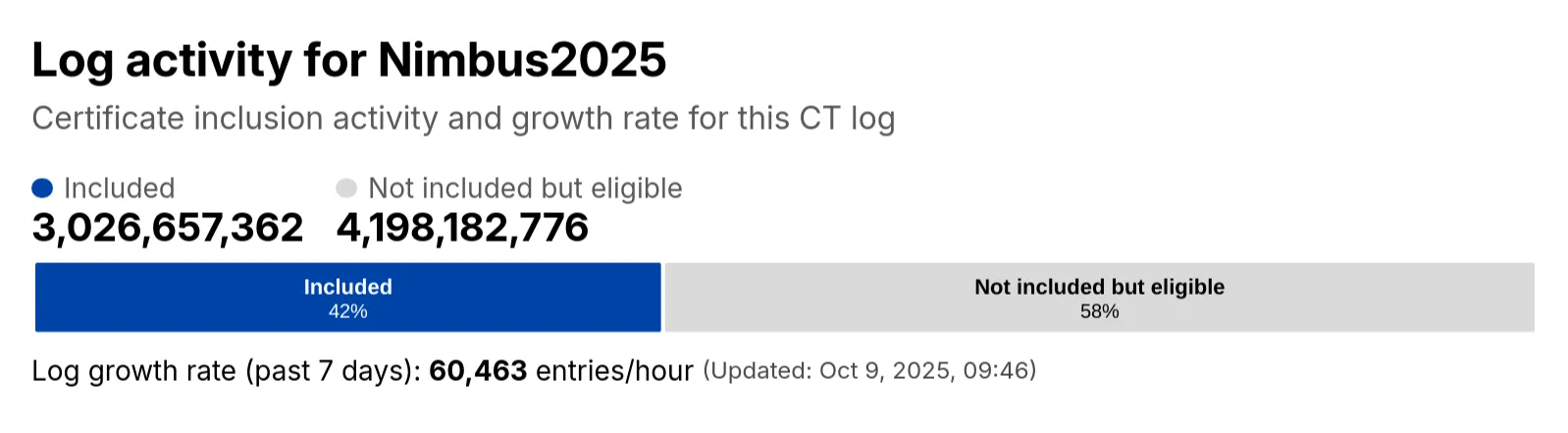
Radar has expanded its Certificate Transparency (CT) log insights with new stats that provide greater visibility into log activity:
Log growth rate: The average throughput of the CT log over the past 7 days, measured in certificates per hour.
Included certificate count: The total number of certificates already included in this CT log.
Eligible-for-inclusion certificate count: The number of certificates eligible for inclusion in this log but not yet included. This metric is based on certificates signed by trusted root CAs within the log’s accepted date range.
Last update: The timestamp of the most recent update to the CT log.
Now, you simply define the directory where your assets are built, and we handle the rest. Check out the examples for what this looks like in Terraform configuration.
# This tracks the existence of your Worker, so that you# can upload code and assets separately from tracking Worker state.resource "cloudflare_worker" "my_app" { account_id = var.account_id name = "my-app"}resource "cloudflare_worker_version" "my_app_version" { account_id = var.account_id worker_id = cloudflare_worker.my_app.id # Just point to your assets directory - that's it! assets = { directory = "./dist/static" } modules = [{ name = "index.js" content_file = "./dist/worker/index.js" content_type = "application/javascript+module" }]}resource "cloudflare_workers_deployment" "my_app_deployment" { account_id = var.account_id script_name = cloudflare_worker.my_app.name strategy = "percentage" versions = [{ version_id = cloudflare_worker_version.my_app_version.id percentage = 100 }]}
What's changed
Under the hood, the Cloudflare Terraform provider now handles the same logic that Wrangler uses for static asset uploads. This includes scanning your assets directory, computing hashes for each file, generating a manifest with file metadata, and calling the Cloudflare API to upload any missing files in chunks. We support large directories with parallel uploads and chunking, and when the asset manifest hash changes, we detect what's changed and trigger an upload for only those changed files.
You can now create and manage Workflows using Terraform, now supported in the Cloudflare Terraform provider v5.11.0 ↗. Workflows allow you to build durable, multi-step applications -- without needing to worry about retrying failed tasks or managing infrastructure.
This release contains significant fixes and improvements including an updated public key for Linux packages. The public key must be updated if it was installed before September 12, 2025 to ensure the repository remains functional after December 4, 2025. Instructions to make this update are available at pkg.cloudflareclient.com.
Changes and improvements
Proxy mode has been enhanced for even faster resolution. Proxy mode now supports SOCKS4, SOCK5, and HTTP CONNECT over an L4 tunnel with custom congestion control optimizations instead of the previous L3 tunnel to Cloudflare's network. This has more than doubled Proxy mode throughput in lab speed testing, by an order of magnitude in some cases.
The MASQUE protocol is now the only protocol that can use Proxy mode. If you previously configured a device profile to use Proxy mode with Wireguard, you will need to select a new WARP mode or switch to the MASQUE protocol. Otherwise, all devices matching the profile will lose connectivity.
Known issues
Devices using WARP client 2025.4.929.0 and up may experience Local Domain Fallback failures if a fallback server has not been configured. To configure a fallback server, refer to Route traffic to fallback server.
This release contains significant fixes and improvements.
Changes and improvements
Proxy mode has been enhanced for even faster resolution. Proxy mode now supports SOCKS4, SOCK5, and HTTP CONNECT over an L4 tunnel with custom congestion control optimizations instead of the previous L3 tunnel to Cloudflare's network. This has more than doubled Proxy mode throughput in lab speed testing, by an order of magnitude in some cases.
The MASQUE protocol is now the only protocol that can use Proxy mode. If you previously configured a device profile to use Proxy mode with Wireguard, you will need to select a new WARP mode or switch to the MASQUE protocol. Otherwise, all devices matching the profile will lose connectivity.
Known issues
For Windows 11 24H2 users, Microsoft has confirmed a regression that may lead to performance issues like mouse lag, audio cracking, or other slowdowns. Cloudflare recommends users experiencing these issues upgrade to a minimum Windows 11 24H2 KB5062553 or higher for resolution.
Devices using WARP client 2025.4.929.0 and up may experience Local Domain Fallback failures if a fallback server has not been configured. To configure a fallback server, refer to Route traffic to fallback server.
Devices with KB5055523 installed may receive a warning about Win32/ClickFix.ABA being present in the installer. To resolve this false positive, update Microsoft Security Intelligence to version 1.429.19.0 or later.
DNS resolution may be broken when the following conditions are all true:
WARP is in Secure Web Gateway without DNS filtering (tunnel-only) mode.
A custom DNS server address is configured on the primary network adapter.
The custom DNS server address on the primary network adapter is changed while WARP is connected.
To work around this issue, reconnect the WARP client by toggling off and back on.
This release contains significant fixes and improvements.
Changes and improvements
Proxy mode has been enhanced for even faster resolution. Proxy mode now supports SOCKS4, SOCK5, and HTTP CONNECT over an L4 tunnel with custom congestion control optimizations instead of the previous L3 tunnel to Cloudflare's network. This has more than doubled Proxy mode throughput in lab speed testing, by an order of magnitude in some cases.
The MASQUE protocol is now the only protocol that can use Proxy mode. If you previously configured a device profile to use Proxy mode with Wireguard, you will need to select a new WARP mode or switch to the MASQUE protocol. Otherwise, all devices matching the profile will lose connectivity.
Known issues
macOS Sequoia: Due to changes Apple introduced in macOS 15.0.x, the WARP client may not behave as expected. Cloudflare recommends the use of macOS 15.4 or later.
Devices using WARP client 2025.4.929.0 and up may experience Local Domain Fallback failures if a fallback server has not been configured. To configure a fallback server, refer to Route traffic to fallback server.
The most common reason users contact Cloudflare support is lost two-factor authentication (2FA) credentials. Cloudflare supports both app-based and hardware keys for 2FA, but you could lose access to your account if you lose these. Over the past few weeks, we have been rolling out email and in-product reminders that remind you to also download backup codes (sometimes called recovery keys) that can get you back into your account in the event you lose your 2FA credentials. Download your backup codes now by logging into Cloudflare, then navigating to Profile > Security & Authentication > Backup codes.
Sign-in security best practices
Cloudflare is critical infrastructure, and you should protect it as such. Please review the following best practices and make sure you are doing your part to secure your account.
Use a unique password for every website, including Cloudflare, and store it in a password manager like 1Password or Keeper. These services are cross-platform and simplify the process of managing secure passwords.
Use 2FA to make it harder for an attacker to get into your account in the event your password is leaked
Store your backup codes securely. A password manager is the best place since it keeps the backup codes encrypted, but you can also print them and put them somewhere safe in your home.
If you use an app to manage your 2FA keys, enable cloud backup, so that you don't lose your keys in the event you lose your phone.
If you use a custom email domain to sign in, configure SSO ↗.
If you use a public email domain like Gmail or Hotmail, you can also use social login with Apple, GitHub, or Google to sign in.
If you manage a Cloudflare account for work:
Have at least two administrators in case one of them unexpectedly leaves your company
Use SCIM to automate permissions management for members in your Cloudflare account
This week highlights multiple critical Cisco vulnerabilities (CVE-2025-20363, CVE-2025-20333, CVE-2025-20362). This flaw stems from improper input validation in HTTP(S) requests. An authenticated VPN user could send crafted requests to execute code as root, potentially compromising the device.
The initial two rules were made available on September 28, with a third rule added today, October 7, for more robust protection.
Cisco (CVE-2025-20333, CVE-2025-20362, CVE-2025-20363): Multiple vulnerabilities that could allow attackers to exploit unsafe deserialization and input validation flaws. Successful exploitation may result in arbitrary code execution, privilege escalation, or command injection on affected systems.
Impact
Cisco (CVE-2025-20333, CVE-2025-20362, CVE-2025-20363): Exploitation enables attackers to escalate privileges or achieve remote code execution via command injection.
Administrators are strongly advised to apply vendor updates immediately.
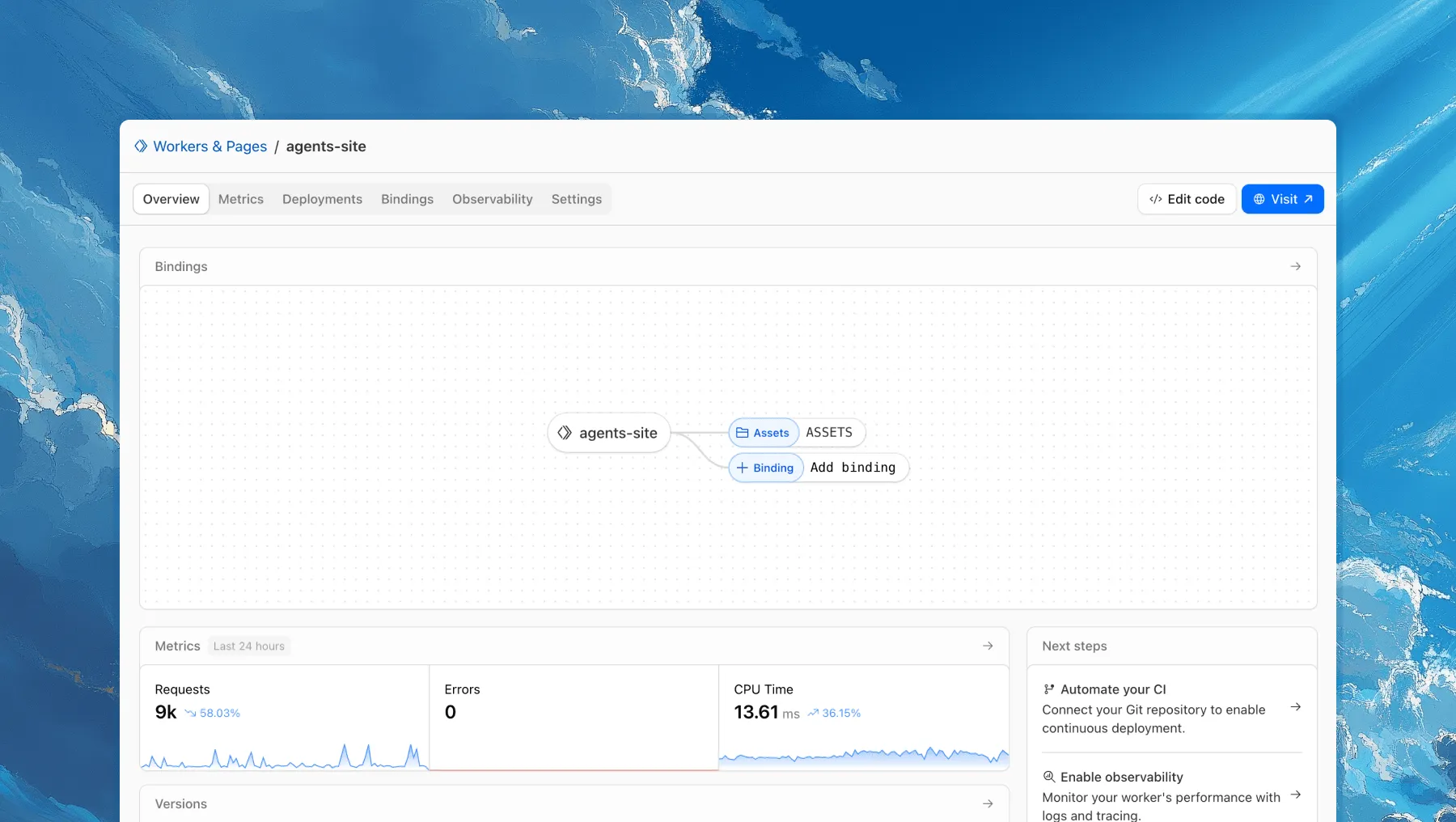
Each of your Workers now has a new overview page in the Cloudflare dashboard.
The goal is to make it easier to understand your Worker without digging through multiple tabs. Think of it as a new home base, a place to get a high-level overview on what's going on.
It's the first place you land when you open a Worker in the dashboard, and it gives you an immediate view of what’s going on. You can see requests, errors, and CPU time at a glance. You can view and add bindings, and see recent versions of your app, including who published them.
Navigation is also simpler, with visually distinct tabs at the top of the page. At the bottom right you'll find guided steps for what to do next that are based on the state of your Worker, such as adding a binding or connecting a custom domain.
We plan to add more here over time. Better insights, more controls, and ways to manage your Worker from one page.
If you have feedback or suggestions for the new Overview page or your Cloudflare Workers experience in general, we'd love to hear from you. Join the Cloudflare developer community on Discord ↗.
Radar now includes browser detection for Post-quantum (PQ) encryption.
The Post-quantum encryption card ↗ now checks whether a user’s browser supports post-quantum encryption.
If support is detected, information about the key agreement in use is displayed.
This week’s highlights prioritise an emergency Oracle E-Business Suite RCE rule deployed to block active, high-impact exploitation. Also addressed are high-severity Chaos Mesh controller command-injection flaws that enable unauthenticated in-cluster RCE and potential cluster compromise, plus a form-data multipart boundary issue that permits HTTP Parameter Pollution (HPP). Two new generic SQLi detections were added to catch inline-comment obfuscation and information disclosure techniques.
Key Findings
New emergency rule released for Oracle E-Business Suite (CVE-2025-61882) addressing an actively exploited remote code execution vulnerability in core business application modules. Immediate mitigation deployed to protect enterprise workloads.
Chaos Mesh (CVE-2025-59358,CVE-2025-59359,CVE-2025-59360,CVE-2025-59361): A GraphQL debug endpoint on the Chaos Controller Manager is exposed without authentication; several controller mutations (cleanTcs, killProcesses, cleanIptables) are vulnerable to OS command injection.
Form-Data (CVE-2025-7783): Attackers who can observe Math.random() outputs and control request fields in form-data may exploit this flaw to perform HTTP parameter pollution, leading to request tampering or data manipulation.
Two new generic SQLi detections added to enhance baseline coverage against inline-comment obfuscation and information disclosure attempts.
Impact
CVE-2025-61882 — Oracle E-Business Suite remote code execution (emergency detection): attacker-controlled input can yield full system compromise, data exfiltration, and operational outage; immediate blocking enforced.
CVE-2025-59358 / CVE-2025-59359 / CVE-2025-59360 / CVE-2025-59361 — Unauthenticated command-injection in Chaos Mesh controllers allowing remote code execution, cluster compromise, and service disruption (high availability risk).
CVE-2025-7783 — Predictable multipart boundaries in form-data enabling HTTP Parameter Pollution; results include request tampering, parameter overwrite, and downstream data integrity loss.
This update introduces 21 new detections in the Cloudflare Managed Ruleset (all currently set to Disabled mode to preserve remediation logic and allow quick activation if needed). The rules cover a broad spectrum of threats - SQL injection techniques, command and code injection, information disclosure of common files, URL anomalies, and cross-site scripting.
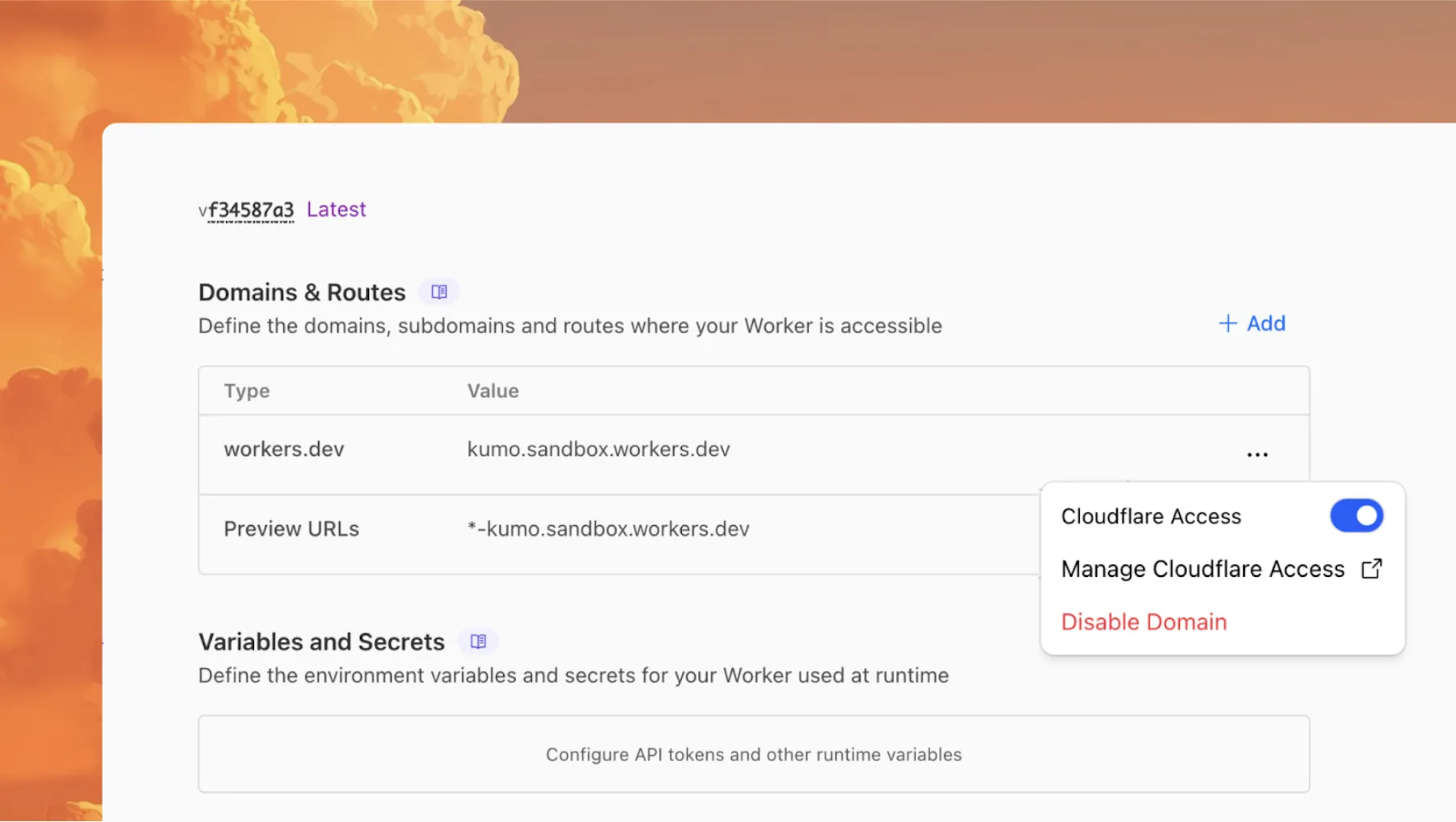
Access allows you to limit access to your Workers to specific users or groups. You can limit access to yourself, your teammates, your organization, or anyone else you specify in your Access policy.
To enable Cloudflare Access:
In the Cloudflare dashboard, go to the Workers & Pages page.
For workers.dev or Preview URLs, click Enable Cloudflare Access.
Optionally, to configure the Access application, click Manage Cloudflare Access. There, you can change the email addresses you want to authorize. View Access policies to learn about configuring alternate rules.
To fully secure your application, it is important that you validate the JWT that Cloudflare Access adds to the Cf-Access-Jwt-Assertion header on the incoming request.
Both of these appear in the modal that appears when you enable Cloudflare Access.
You can set these variables by adding them to your Worker's Wrangler configuration file, or via the Cloudflare dashboard under Workers & Pages > your-worker > Settings > Environment Variables.
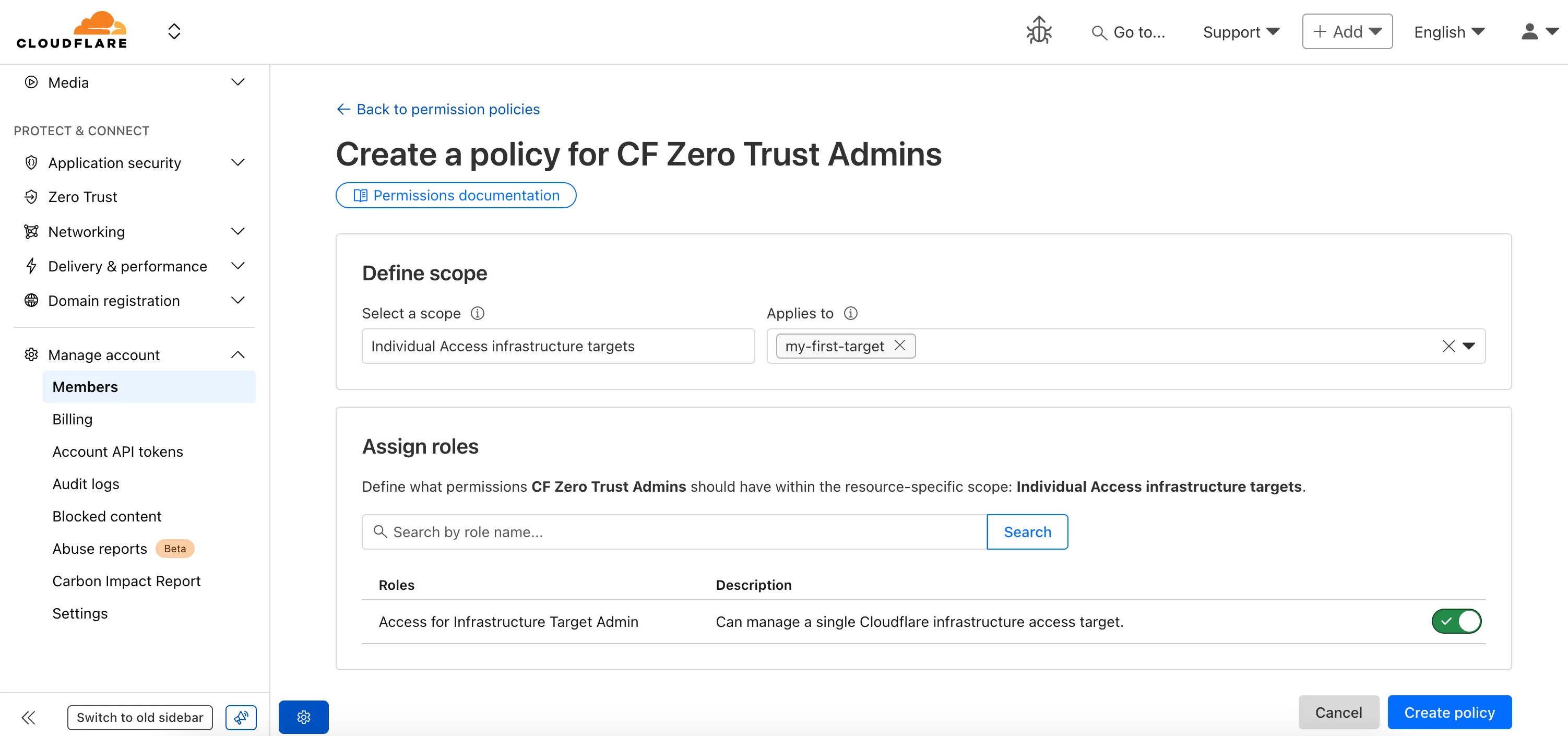
Fine-grained permissions for Access Applications, Identity Providers (IdPs), and Targets is now available in Public Beta. This expands our RBAC model beyond account & zone-scoped roles, enabling administrators to grant permissions scoped to individual resources.
Deepgram's newest Flux model @cf/deepgram/flux is now available on Workers AI, hosted directly on Cloudflare's infrastructure. We're excited to be a launch partner with Deepgram and offer their new Speech Recognition model built specifically for enabling voice agents. Check out Deepgram's blog ↗ for more details on the release.
The Flux model can be used in conjunction with Deepgram's speech-to-text model @cf/deepgram/nova-3 and text-to-speech model @cf/deepgram/aura-1 to build end-to-end voice agents. Having Deepgram on Workers AI takes advantage of our edge GPU infrastructure, for ultra low latency voice AI applications.
Promotional Pricing
For the month of October 2025, Deepgram's Flux model will be free to use on Workers AI. Official pricing will be announced soon and charged after the promotional pricing period ends on October 31, 2025. Check out the model page for pricing details in the future.
Example Usage
The new Flux model is WebSocket only as it requires live bi-directional streaming in order to recognize speech activity.
Create a worker that establishes a websocket connection with @cf/deepgram/flux
Write a client script to connect to your worker and start sending random audio bytes to it
const ws = new WebSocket('wss://<your-worker-url.com>');ws.onopen = () => { console.log('Connected to WebSocket'); // Generate and send random audio bytes // You can replace this part with a function // that reads from your mic or other audio source const audioData = generateRandomAudio(); ws.send(audioData); console.log('Audio data sent');};ws.onmessage = (event) => { // Transcription will be received here // Add your custom logic to parse the data console.log('Received:', event.data);};ws.onerror = (error) => { console.error('WebSocket error:', error);};ws.onclose = () => { console.log('WebSocket closed');};// Generate random audio data (1 second of noise at 44.1kHz, mono)function generateRandomAudio() { const sampleRate = 44100; const duration = 1; const numSamples = sampleRate * duration; const buffer = new ArrayBuffer(numSamples * 2); const view = new Int16Array(buffer); for (let i = 0; i < numSamples; i++) { view[i] = Math.floor(Math.random() * 65536 - 32768); } return buffer;}
You can now perform more powerful queries directly in Workers Analytics Engine ↗ with a major expansion of our SQL function library.
Workers Analytics Engine allows you to ingest and store high-cardinality data at scale (such as custom analytics) and query your data through a simple SQL API.
Today, we've expanded Workers Analytics Engine's SQL capabilities with several new functions:
toUInt8() - Converts any numeric expression, or expression resulting in a string representation of a decimal, into an unsigned 8 bit integer
Ready to get started?
Whether you're building usage-based billing systems, customer analytics dashboards, or other custom analytics, these functions let you get the most out of your data. Get started with Workers Analytics Engine and explore all available functions in our SQL reference documentation.
The GraphQL Analytics API now supports confidence intervals for sum and count fields on adaptive (sampled) datasets. Confidence intervals provide a statistical range around sampled results, helping verify accuracy and quantify uncertainty.
New instance types provide up to 4 vCPU, 12 GiB of memory, and 20 GB of disk per container instance.
Instance Type
vCPU
Memory
Disk
lite
1/16
256 MiB
2 GB
basic
1/4
1 GiB
4 GB
standard-1
1/2
4 GiB
8 GB
standard-2
1
6 GiB
12 GB
standard-3
2
8 GiB
16 GB
standard-4
4
12 GiB
20 GB
The dev and standard instance types are preserved for backward compatibility and are aliases for lite and standard-1, respectively. The standard-1 instance type now provides up to 8 GB of disk instead of only 4 GB.
You can now enhance your security posture by blocking additional application installer and disk image file types with Cloudflare Gateway. Preventing the download of unauthorized software packages is a critical step in securing endpoints from malware and unwanted applications.
We have expanded Gateway's file type controls to include:
Executable: Microsoft Software Installer (msix), Microsoft Software Installer (appx), Apple Software Package (pkg)
To ensure these file types are blocked effectively, please note the following behaviors:
DMG: Due to their file structure, DMG files are blocked at the very end of the transfer. A user's download may appear to progress but will fail at the last moment, preventing the browser from saving the file.
MSIX: To comprehensively block Microsoft Software Installers, you should also include the file type Unscannable. MSIX files larger than 100 MB are identified as Unscannable ZIP files during inspection.
To get started, go to your HTTP policies in Zero Trust. For a full list of file types, refer to supported file types.
Users can now specify that they want to retrieve Cloudflare documentation as markdown rather than the previous HTML default. This can significantly reduce token consumption when used alongside Large Language Model (LLM) tools.
Improvements to maintain client connectivity during network changes.
Known issues
For Windows 11 24H2 users, Microsoft has confirmed a regression that may lead to performance issues like mouse lag, audio cracking, or other slowdowns. Cloudflare recommends users experiencing these issues upgrade to a minimum Windows 11 24H2 KB5062553 or higher for resolution.
Devices using WARP client 2025.4.929.0 and up may experience Local Domain Fallback failures if a fallback server has not been configured. To configure a fallback server, refer to Route traffic to fallback server.
Devices with KB5055523 installed may receive a warning about Win32/ClickFix.ABA being present in the installer. To resolve this false positive, update Microsoft Security Intelligence to version 1.429.19.0 or later.
DNS resolution may be broken when the following conditions are all true:
WARP is in Secure Web Gateway without DNS filtering (tunnel-only) mode.
A custom DNS server address is configured on the primary network adapter.
The custom DNS server address on the primary network adapter is changed while WARP is connected.
To work around this issue, reconnect the WARP client by toggling off and back on.
MASQUE is now the default tunnel protocol for all new WARP device profiles.
Improvement to limit idle connections in Gateway with DoH mode to avoid unnecessary resource usage that can lead to DoH requests not resolving.
Improvements to maintain client connectivity during network changes.
The WARP client now supports macOS Tahoe (version 26.0).
Known issues
macOS Sequoia: Due to changes Apple introduced in macOS 15.0.x, the WARP client may not behave as expected. Cloudflare recommends the use of macOS 15.4 or later.
Devices using WARP client 2025.4.929.0 and up may experience Local Domain Fallback failures if a fallback server has not been configured. To configure a fallback server, refer to Route traffic to fallback server.