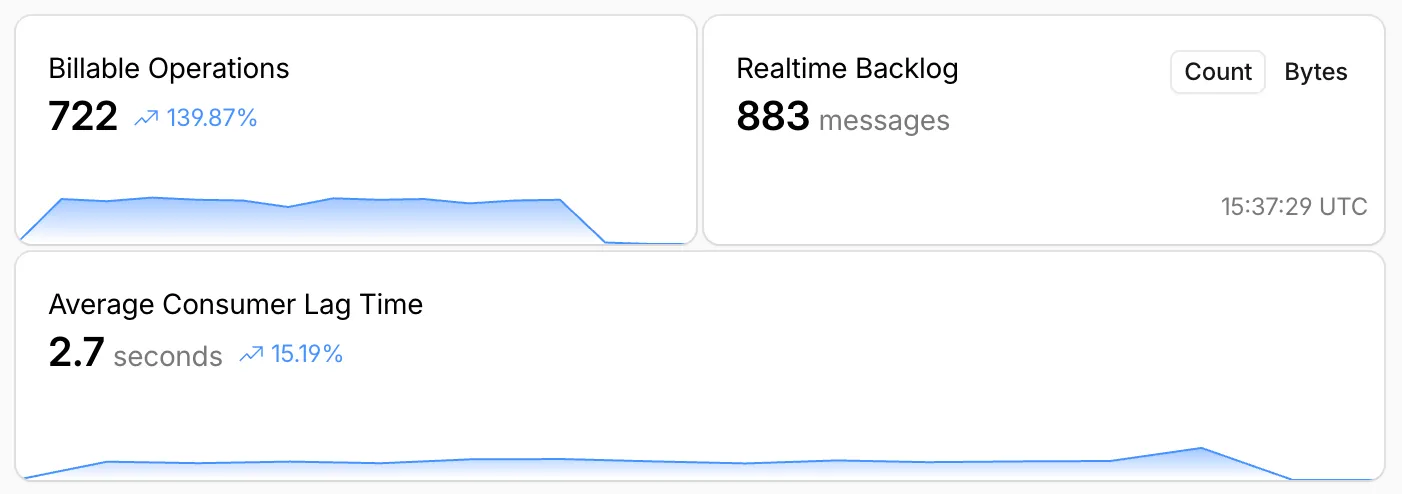
Queues, Cloudflare's managed message queue, now exposes realtime backlog metrics via the dashboard, REST API, and JavaScript API. Three new fields are available:
backlog_count — the number of unacknowledged messages in the queue
backlog_bytes — the total size of those messages in bytes
oldest_message_timestamp_ms — the timestamp of the oldest unacknowledged message
The following endpoints also now include a metadata.metrics object on the result field after successful message consumption:
The Support button in the dashboard global navigation header now takes you directly to the Cloudflare Support Portal ↗, eliminating the previous dropdown menu.
This change ensures that when you need help, you spend less time navigating the UI and more time getting the answers you need.
What changed?
Previous behavior: Selecting ? Support opened a dropdown menu with various links (Help Center, Cloudflare Community, etc.).
New behavior: Selecting Support immediately redirects your current tab to the Support Portal.
Cache Response Rules now work with Version Management. You can version response-phase cache settings and promote them through environments, just like Cache Rules and other supported configurations.
What changed
Previously, Cache Response Rules were excluded from zone versioning. Any response-phase rule you created applied globally across all environments with no way to test changes in staging first. Cache Rules already supported versioning, but the response phase, where you modify Cache-Control directives, manage cache tags, and strip headers, did not.
Cache Response Rules are now fully integrated with Version Management. You can create or modify response-phase rules within a version, and those changes stay scoped to that version until promoted.
Benefits
Safe rollout of cache behavior changes: Test response-phase rules in a staging environment before promoting to production. Catch unintended caching side effects early.
Parity with Cache Rules: Cache Response Rules now follow the same versioning workflow as Cache Rules, so you can manage all cache configuration through a single promotion pipeline.
Independent environment control: Run different response-phase cache settings per environment. For example, strip Set-Cookie headers in staging to validate cacheability without affecting production traffic.
Cloudflare-generated 5xx error responses now return structured JSON and Markdown when agents request them, matching the format already available for 1xxx errors. Responses follow RFC 9457 (Problem Details for HTTP APIs) ↗ and include a Retry-After HTTP header on retryable codes.
Changes
5xx coverage. Ten Cloudflare-generated error codes (500, 502, 504, 520-526) now serve structured responses. These are errors Cloudflare itself generates when it cannot reach or understand the origin server. Origin-generated 5xx responses that Cloudflare passes through are not affected.
Fault attribution. The error_category field tells agents where the fault lies:
origin (502, 504, 520-524) — the origin server is responsible. Transient; retry with the backoff in retry_after.
cloudflare (500) — Cloudflare's fault, not the website or the request. Short retry.
ssl (525, 526) — the origin's TLS configuration is broken. Do not retry.
Retry-After header. Retryable codes (500, 502, 504, 520-524) include a Retry-After HTTP header matching the retry_after body field. Non-retryable codes (525, 526) do not include the header.
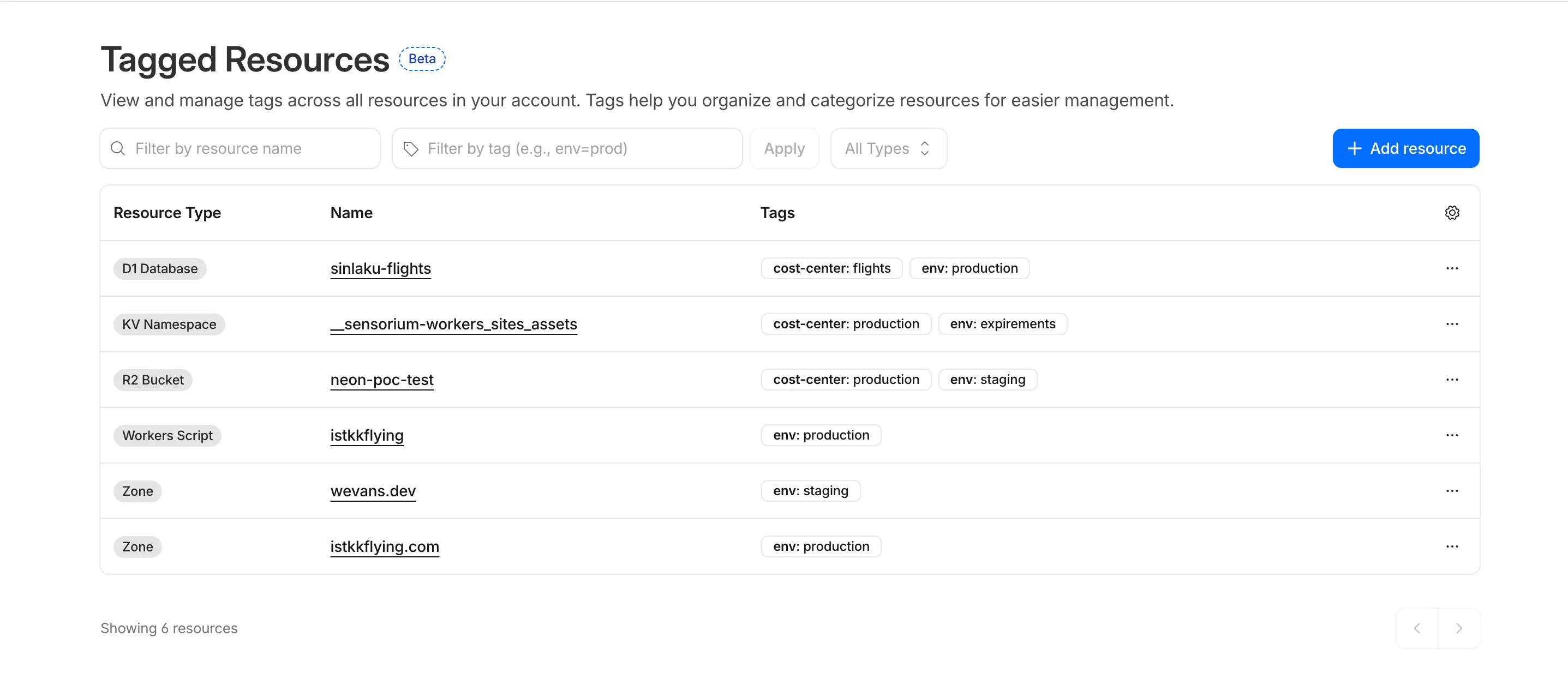
Resource Tagging is now in public beta and rolling out to all Cloudflare accounts over the coming days. You can attach custom key-value metadata to your Cloudflare resources and query across your entire account to find what you need.
What's included
Broad resource type support — Tag zones, custom hostnames, Cloudflare Tunnels, Workers, D1 databases, R2 buckets, KV namespaces, Durable Object namespaces, Queues, Stream videos, Images, Access applications, Gateway rules, AI Gateways, and more. Refer to the full list of supported resource types.
Powerful filtering — Query tagged resources using AND/OR logic, negation, and key-only matching. Combine up to 20 filters per query to build precise resource views.
Account and zone-level endpoints — Full CRUD operations across both scopes.
Token-based authentication — Tagging supports Account Owned Tokens that persist independently of individual users, so your automation keeps running through credential rotations and team changes.
Flexible role support — Super Administrators, Workers Admins, and Tag Admins can all manage tags.
API-first by design
The API is the primary interface for Resource Tagging and the recommended path for all workflows — scripting tag assignments, building CI/CD pipelines, or integrating with your infrastructure-as-code toolchain.
Dashboard UI
You can also view and manage tagged resources directly in the Cloudflare dashboard. Navigate to Manage Account > Resource Tagging to see all tagged resources across your account, filter by resource name or tag, and add or edit tags inline.
What's coming next
In future releases, expect support for additional resource types across the Cloudflare platform, tag-based access control policies for scoping user permissions to tagged resources, billing and usage attribution by tag for breaking down costs by team, project, or environment, and Terraform provider support for managing tags declaratively.
Current limitations
PUT replaces all tags on a resource (no partial update). Use the GET, merge, PUT workflow to modify individual tags safely.
DELETE removes all tags from a resource. To remove a single tag, PUT the remaining tags back.
Querying tags for a resource that has never been tagged returns 500 instead of 404. This is a known beta limitation.
We have introduced a unified investigation workspace within Brand Protection to help analysts manage complex brand portfolios. Instead of jumping between individual queries, you can now consolidate your workflow into a single, cohesive view.
What's new
You can now elect multiple saved queries from your dashboard to generate a consolidated "Combined Matches" view. This allows you to triage results from different brand queries in one unified table
You can open query extended views in distinct tabs within the Brand Protection dashboard. This enables you to maintain multiple investigation contexts simultaneously and switch between them without losing your place.
You can reset your workspace using the new "Clear Selection" action, making it easier to pivot between different investigation sets.
Key benefits
Eliminate fragmented workflows by viewing all matches across different query buckets in a single table, reducing the need to click through dozens of individual query pages
Correlate related campaigns by seeing similar domains or infrastructure patterns that appear across multiple saved queries
This week's release focuses on new improvements to enhance coverage.
Key Findings
Existing rule enhancements have been deployed to improve detection resilience against broad classes of web attacks and strengthen behavioral coverage.
Continuous Rule Improvements
We are continuously refining our managed rules to provide more resilient protection and deeper insights into attack patterns. To ensure an optimal security posture, we recommend consistently monitoring the Security Events dashboard and adjusting rule actions as these enhancements are deployed.
Ruleset
Rule ID
Legacy Rule ID
Description
Previous Action
New Action
Comments
Cloudflare Managed Ruleset
N/A
PostgreSQL - SQLi - COPY - Beta
Log
Block
This is a new detection. This rule is merged into the original rule
"PostgreSQL - SQLi - COPY - Body (ID: ). The rule previously known as "PostgreSQL - SQLi - COPY" is now renamed to "PostgreSQL - SQLi - COPY - Body".
Cloudflare Managed Ruleset
N/A
PostgreSQL - SQLi - COPY - Headers
Log
Block
This is a new detection.
Cloudflare Managed Ruleset
N/A
PostgreSQL - SQLi - COPY - URI
Log
Block
This is a new detection.
Cloudflare Managed Ruleset
N/A
SQLi - AND/OR MAKE_SET/ELT - Beta
Log
Block
This is a new detection. This rule is merged into the original rule
"SQLi - AND/OR MAKE_SET/ELT - Body" (ID: ). The rule previously known as "SQLi - AND/OR MAKE_SET/ELT" is now renamed to "SQLi - AND/OR MAKE_SET/ELT - Body".
Cloudflare Managed Ruleset
N/A
SQLi - AND/OR MAKE_SET/ELT - Headers
Log
Block
This is a new detection.
Cloudflare Managed Ruleset
N/A
SQLi - AND/OR MAKE_SET/ELT - URI
Log
Block
This is a new detection.
Cloudflare Managed Ruleset
N/A
SQLi - Common Patterns - Beta
Log
Block
This is a new detection. This rule is merged into the original rule
"SQLi - Common Patterns - Body" (ID: ). The rule previously known as "SQLi - Common Patterns" is now renamed to "SQLi - Common Patterns - Body".
Cloudflare Managed Ruleset
N/A
SQLi - Common Patterns - Headers
Log
Block
This is a new detection.
Cloudflare Managed Ruleset
N/A
SQLi - Common Patterns - URI
Log
Block
This is a new detection.
Cloudflare Managed Ruleset
N/A
SQLi - Equation - Beta
Log
Block
This is a new detection. This rule is merged into the original rule
"SQLi - Equation - Body" (ID: ). The rule previously known as "SQLi - Equation" is now renamed to "SQLi - Equation - Body".
Cloudflare Managed Ruleset
N/A
SQLi - Equation - Headers
Log
Block
This is a new detection.
Cloudflare Managed Ruleset
N/A
SQLi - Equation - URI
Log
Block
This is a new detection.
Cloudflare Managed Ruleset
N/A
SQLi - AND/OR Digit Operator Digit - Beta
Log
Block
This is a new detection. This rule is merged into the original rule
"SQLi - AND/OR Digit Operator Digit - Body" (ID: ). The rule previously known as "SQLi - AND/OR Digit Operator Digit" is now renamed to "SQLi - AND/OR Digit Operator Digit - Body".
Cloudflare Managed Ruleset
N/A
SQLi - AND/OR Digit Operator Digit - Headers
Log
Block
This is a new detection.
Cloudflare Managed Ruleset
N/A
SQLi - AND/OR Digit Operator Digit - URI
Log
Block
This is a new detection.
Cloudflare Managed Ruleset
N/A
SQLi - Benchmark Function - Beta
Log
Block
This is a new detection. This rule is merged into the original rule
"SQLi - Benchmark Function - Body" (ID: ). The rule previously known as "SQLi - Benchmark Function" is now renamed to "SQLi - Benchmark Function - Body".
Cloudflare Managed Ruleset
N/A
SQLi - Benchmark Function - Headers
Log
Block
This is a new detection.
Cloudflare Managed Ruleset
N/A
SQLi - Benchmark Function - URI
Log
Block
This is a new detection.
Cloudflare Managed Ruleset
N/A
SQLi - Comparison - Beta
Log
Block
This is a new detection. This rule is merged into the original rule
"SQLi - Comparison - Body" (ID: ). The rule previously known as "SQLi - Comparison" is now renamed to "SQLi - Comparison - Body".
Cloudflare Managed Ruleset
N/A
SQLi - Comparison - Headers
Log
Block
This is a new detection.
Cloudflare Managed Ruleset
N/A
SQLi - Comparison - URI
Log
Block
This is a new detection.
Cloudflare Managed Ruleset
N/A
SQLi - String Concatenation - Body - Beta
Log
Block
This is a new detection. This rule is merged into the original rule "SQLi - String Concatenation - Headers" (ID: ).The rule previously known as "SQLi - String Concatenation - Headers" is now renamed to "SQLi - String Concatenation - Body".
Cloudflare Managed Ruleset
N/A
SQLi - String Concatenation - Headers
Log
Block
This is a new detection.(Former Id was )
Cloudflare Managed Ruleset
N/A
SQLi - String Concatenation - URI
Log
Block
This is a new detection. (Former Id was )
Cloudflare Managed Ruleset
N/A
SQLi - SELECT Expression - Beta
Log
Block
This is a new detection. This rule is merged into the original rule
"SQLi - SELECT Expression - Body" (ID: ). The rule previously known as "SQLi - SELECT Expression" is now renamed to "SQLi - SELECT Expression - Body".
Cloudflare Managed Ruleset
N/A
SQLi - SELECT Expression - Headers
Log
Block
This is a new detection.
Cloudflare Managed Ruleset
N/A
SQLi - SELECT Expression - URI
Log
Block
This is a new detection.
Cloudflare Managed Ruleset
N/A
SQLi - ORD and ASCII - Beta
Log
Block
This is a new detection. This rule is merged into the original rule
"SQLi - ORD and ASCII- Body" (ID: ). The rule previously known as "SQLi - ORD and ASCII" is now renamed to "SQLi - ORD and ASCII- Body".
Customers who already consume the zero_trust_network_sessions dataset via Logpush or Log Explorer may see increased log volume if they use these on-ramps.
Terraform Provider v5.19.0 introduces 14 new resources spanning AI Gateway, Pipelines, R2 Data Catalog, User Groups, Vulnerability Scanner, Workers Observability, and Zero Trust capabilities. This release significantly improves the v4 to v5 migration experience with automatic state upgraders for 26 resources, working seamlessly with the new tf-migrate CLI tool ↗ to automate resource renames, attribute updates, and moved block generation. Together, these enhancements reduce manual migration effort and minimize risk when upgrading from v4 to v5.
Note:cmd/migrate is deprecated in favor of tf-migrate and will be removed in a future release (#7062 ↗)
New Resources
cloudflare_ai_gateway: Manage AI Gateway instances
We're excited to announce tf-migrate, a purpose-built CLI tool that simplifies migrating from Cloudflare Terraform Provider v4 to v5.
v5 is stable and ready for production
Terraform Provider v5 is stable and actively receiving updates. We encourage all users to migrate to v5 to take advantage of ongoing enhancements and new capabilities.
Cloudflare uses tf-migrate to migrate our own infrastructure — the same tool we're providing to the community — ensuring the best possible migration experience.
What tf-migrate does
tf-migrate automates the tedious and error-prone parts of the v4 to v5 migration process:
Resource type renames – Automatically updates cloudflare_record → cloudflare_dns_record, cloudflare_access_application → cloudflare_zero_trust_access_application, and 40+ other renamed resources
Attribute transformations – Updates field names (e.g., value → content for DNS records) and restructures nested blocks
Moved block generation – Creates Terraform 1.8+ moved blocks to prevent resource replacements and ensure zero-downtime migrations
Cross-file reference updates – Automatically finds and updates all references to renamed resources across your entire configuration
Dry-run mode – Preview all changes before applying them to ensure safety
Combined with the automatic state upgraders introduced in v5.19+, tf-migrate eliminates the manual work and risk that previously made v5 migrations challenging. Tf-migrate operates directly on the config, and the built-in state upgraders handle the rest.
Supported resources
Tf-migrate currently supports the most common Terraform resources our customers use. We are actively working to expand coverage, with the most commonly used resources prioritized first.
For the complete list of supported resources and their migration status, refer to the v5 Stabilization Tracker ↗. This list is updated regularly as additional resources are stabilized and migration support is added.
Resources not yet supported by tf-migrate will need to be migrated manually using the version 5 upgrade guide ↗. The upgrade guide provides step-by-step instructions for handling resource renames, attribute changes, and state migrations.
We have been releasing Betas over the past month and a half while testing this tool. See the full changelog of those Betas here: tf-migrate releases ↗.
Independent MFA in Cloudflare Access now supports two additional organization-level controls:
Restrict authenticators by AAGUID — Limit enrollment to a specific set of WebAuthn authenticators using their AAGUID ↗. This is useful for organizations that require FIPS-validated security keys or company-issued hardware. AAGUIDs are managed through a new List type.
AMR matching — Skip the independent MFA prompt when the identity provider has already performed an equivalent MFA. Access reads the amr claim defined in RFC 8176 ↗ and matches supported values such as hwk, otp, and fpt to the authenticator types allowed on the application or policy. This prevents users from having to complete MFA twice when their identity provider already enforces it.
Audit Logs v2 now supports organization-level audit logs. Org Admins can retrieve audit events for actions performed at the organization level via the Audit Logs v2 API.
To retrieve organization-level audit logs, use the following endpoint:
GET https://api.cloudflare.com/client/v4/organizations/{organization_id}/logs/audit
This release covers user-initiated actions performed through organization-level APIs. Audit logs for system-initiated actions, a dashboard UI, and Logpush support for organizations will be added in future releases.
In this release, you'll see a number of breaking changes. This is primarily due to changes in OpenAPI definitions, which our libraries are based off of, and codegen updates that we rely on to read those OpenAPI definitions and produce our SDK libraries.
Please ensure you read through the list of changes below before moving to this version - this will help you understand any down or upstream issues it may cause to your environments.
Breaking Changes
See the v6.10.0 Migration Guide ↗ for before/after code examples and actions needed for each change.
Abuse Reports - Registrar WHOIS Report Field Removals
Several fields have been removed from AbuseReportNewParamsBodyAbuseReportsRegistrarWhoisReportRegWhoRequest:
RegWhoGoodFaithAffirmation
RegWhoLawfulProcessingAgreement
RegWhoLegalBasis
RegWhoRequestType
RegWhoRequestedDataElements
AI Search - Instance Params Restructured
The InstanceNewParams and InstanceUpdateParams types have been significantly restructured. Many fields have been moved or removed:
InstanceSearchParams.Messages field removed along with InstanceSearchParamsMessage and InstanceSearchParamsMessagesRole types
AI Search - InstanceItem Service Removed
The InstanceItemService type has been removed. The items sub-resource at client.AISearch.Instances.Items no longer exists in the non-namespace path. Use client.AISearch.Namespaces.Instances.Items instead.
AI Search - Token Types Removed
The following types have been removed from the ai_search package:
Email Security - Investigate Move Return Type Change
The Investigate.Move.New() method now returns a raw slice instead of a paginated wrapper:
New() returns *[]InvestigateMoveNewResponse instead of *pagination.SinglePage[InvestigateMoveNewResponse]
NewAutoPaging() method removed
Hyperdrive - Config Params Restructured
The ConfigEditParams type lost its MTLS and Name fields. The HyperdriveMTLSParam type lost MTLS and Host fields. The Host field on origin config changed from param.Field[string] to a plain string.
IAM - UserGroupMember Params and Return Types Changed
The UserGroupMemberNewParams struct has been restructured and the New() method now returns a paginated response:
UserGroupMemberNewParams.Body renamed to UserGroupMemberNewParams.Members
UserGroupMemberNewParamsBody renamed to UserGroupMemberNewParamsMember
UserGroupMemberUpdateParams.Body renamed to UserGroupMemberUpdateParams.Members
UserGroupMemberUpdateParamsBody renamed to UserGroupMemberUpdateParamsMember
UserGroups.Members.New() returns *pagination.SinglePage[UserGroupMemberNewResponse] instead of *UserGroupMemberNewResponse
IAM - UserGroup List Direction Type Changed
The UserGroupListParams.Direction field changed from param.Field[string] to param.Field[UserGroupListParamsDirection] (typed enum with asc/desc values).
Pipelines - Delete Methods Now Return Typed Responses
Several delete methods across Pipelines now return typed responses instead of bare error:
Pipelines.DeleteV1() returns (*PipelineDeleteV1Response, error) instead of error
Pipelines.Sinks.Delete() returns (*SinkDeleteResponse, error) instead of error
Pipelines.Streams.Delete() returns (*StreamDeleteResponse, error) instead of error
Queues - Message Response Types Removed
The following response envelope types have been removed:
MessageBulkPushResponseSuccess
MessagePushResponseSuccess
MessageAckResponse fields RetryCount and Warnings removed
Secrets Store - Pagination Wrapper Removal and Type Changes
Methods now return direct types instead of SinglePage wrappers, and several internal types have been removed. Associated AutoPaging methods have also been removed:
Stores.New() returns *StoreNewResponse instead of *pagination.SinglePage[StoreNewResponse]
Stores.NewAutoPaging() method removed
Stores.Secrets.BulkDelete() returns *StoreSecretBulkDeleteResponse instead of *pagination.SinglePage[StoreSecretBulkDeleteResponse]
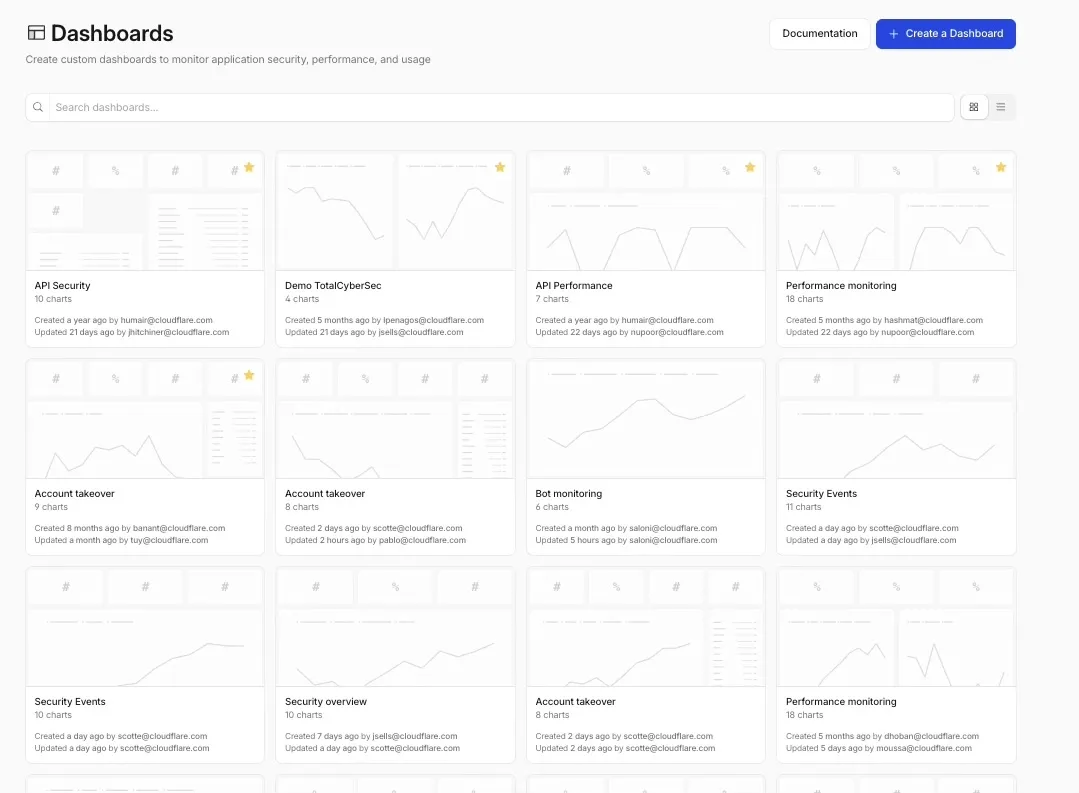
Custom Dashboards are now available to all Cloudflare customers. Build personalized views that highlight the metrics most critical to your infrastructure and security posture, moving beyond standard product dashboards.
This update significantly expands the data available for visualization. Build charts based on any of the 100+ datasets available via the Cloudflare GraphQL API, covering everything from WAF events and Workers metrics to Load Balancing and Zero Trust logs.
Log Explorer integration
For Log Explorer customers, you can now turn raw log queries directly into dashboard charts. When you identify a specific pattern or spike while investigating logs, save that query as a visualization to monitor those signals in real-time without leaving the dashboard.
Key benefits
Unified visibility: Consolidate signals from different Cloudflare products (for example, HTTP Traffic and R2 Storage) into a single view.
Flexible monitoring: Create charts that focus on specific status codes, ASN regions, or security actions that matter to your business.
Expanded limits: Log Explorer customers can create up to 100 dashboards (up from 25 for standard customers).
R2 Data Catalog, a managed Apache Iceberg ↗ catalog built into R2, now removes unreferenced data files during automatic snapshot expiration. This improvement reduces storage costs and eliminates the need to run manual maintenance jobs to reclaim space from deleted data.
Previously, snapshot expiration only cleaned up Iceberg metadata files such as manifests and manifest lists. Data files that were no longer referenced by active snapshots remained in R2 storage until you manually ran remove_orphan_files or expire_snapshots through an engine like Spark. This required extra operational overhead and left stale data files consuming storage.
Snapshot expiration now handles both metadata and data file cleanup automatically. When a snapshot is expired, any data files that are no longer referenced by retained snapshots are removed from R2 storage.
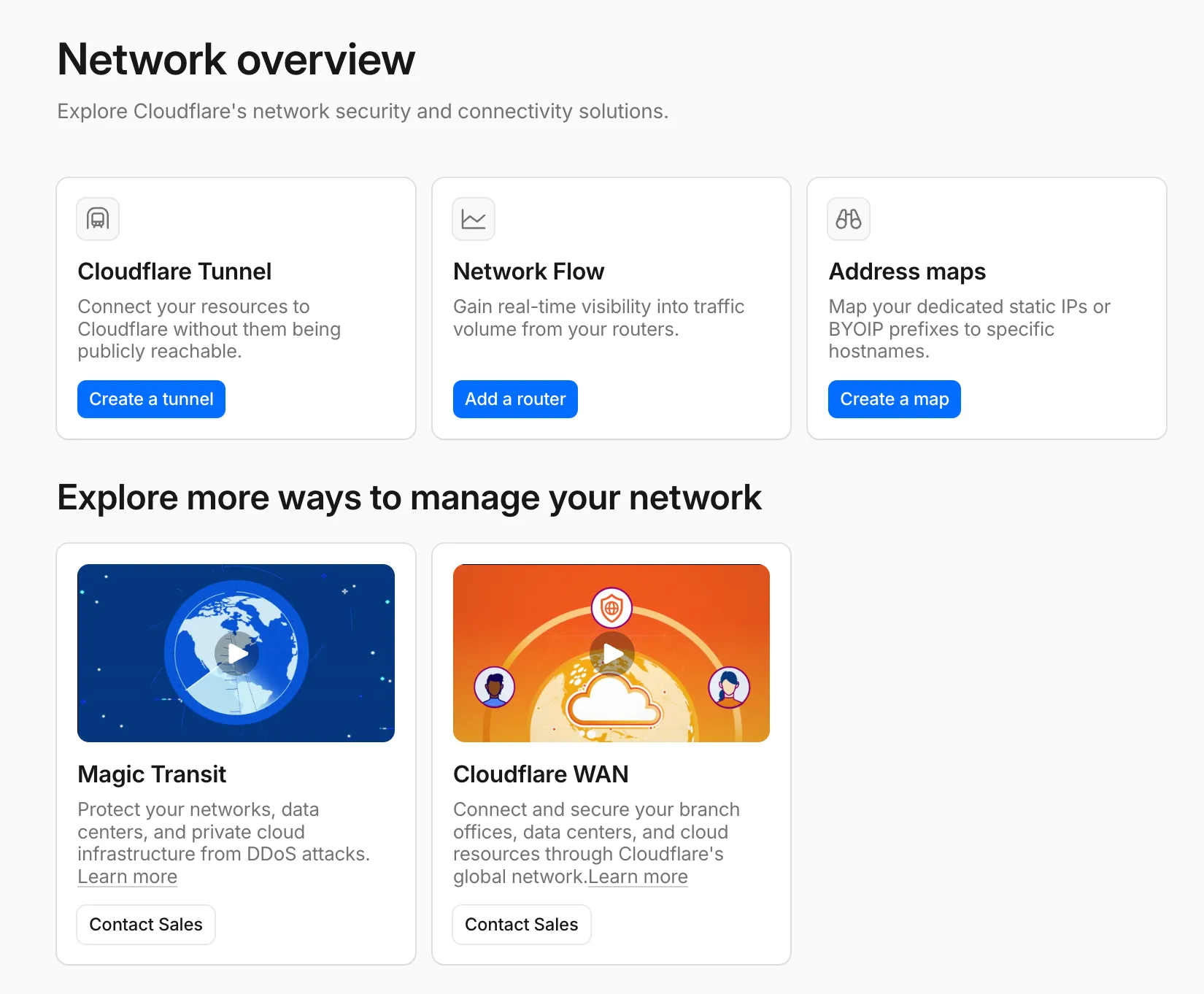
You can create firewall rules that match traffic based on source or destination country to enforce geographic access policies across your network.
This is the first of the Cloudflare Advanced Network Firewall features to become available in Unified Routing. Support for additional features - IP Lists, ASN Lists, Threat Intel Lists, IDS, Rate Limiting, SIP, and Managed Rulesets - is planned.
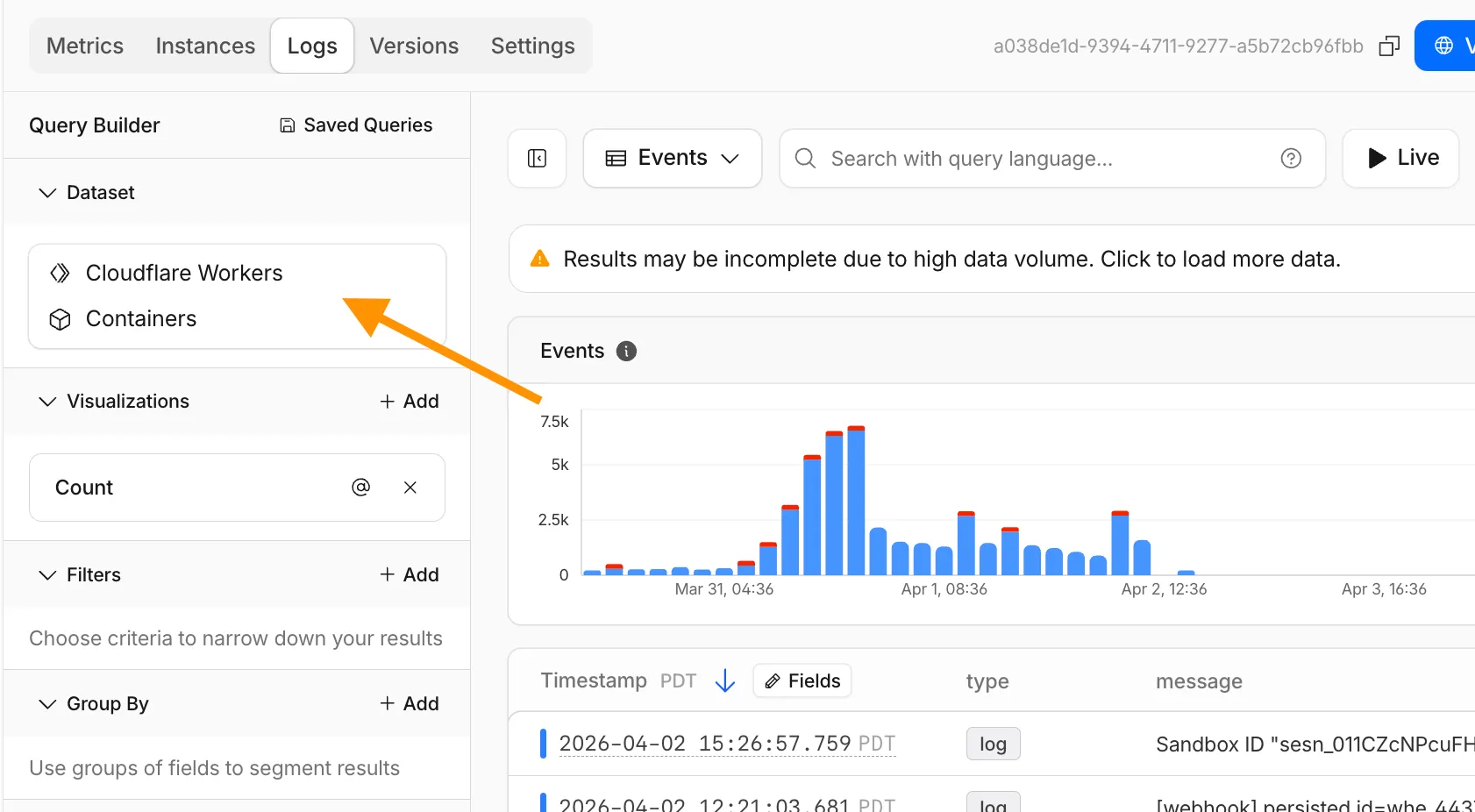
The Container logs page now displays related Worker and Durable Object logs alongside container logs. This co-locates all relevant log events for a container application in one place, making it easier to trace requests and debug issues.
You can filter to a single source when you need to isolate Container, Worker, or Durable Object output.
Pay-as-you-go customers can now monitor usage-based costs and configure spend alerts through two new features: the Billable Usage dashboard and Budget alerts.
Billable Usage dashboard
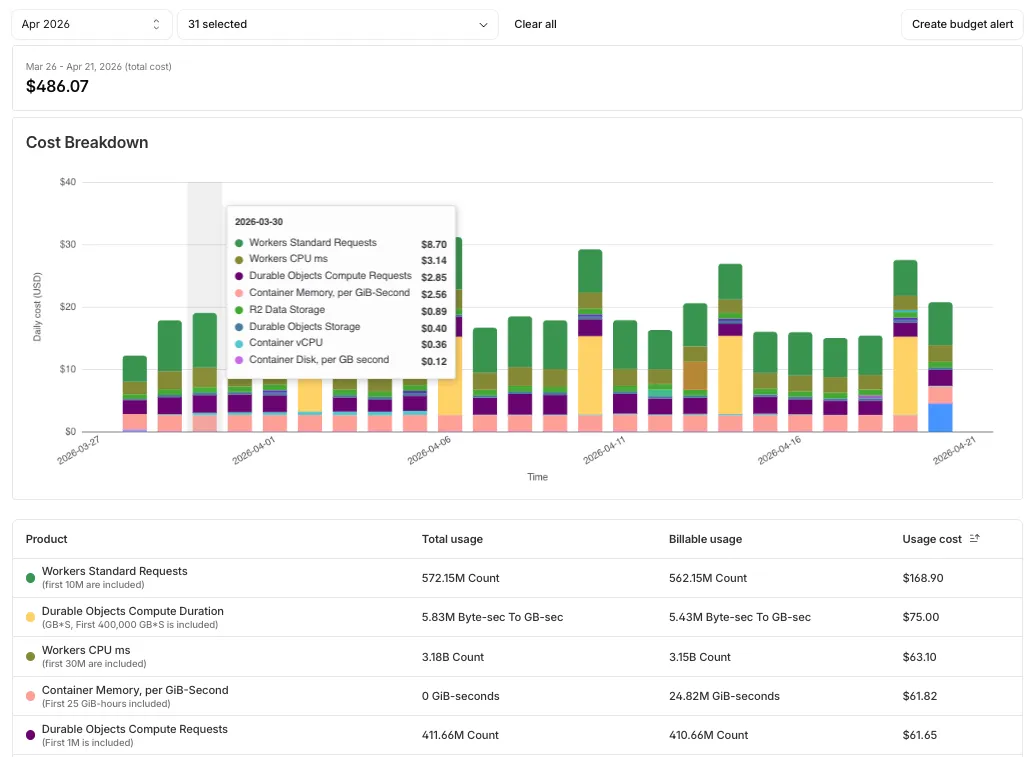
The Billable Usage dashboard provides daily visibility into usage-based costs across your Cloudflare account. The data comes from the same system that generates your monthly invoice, so the figures match your bill.
The dashboard displays:
A bar chart showing daily usage charges for your billing period
A sortable table breaking down usage by product, including total usage, billable usage, and cumulative costs
Ability to view previous billing periods
Usage data aligns to your billing cycle, not the calendar month. The total usage cost shown at the end of a completed billing period matches the usage overage charges on your corresponding invoice.
To access the dashboard, go to Manage Account > Billing > Billable Usage.
Budget alerts
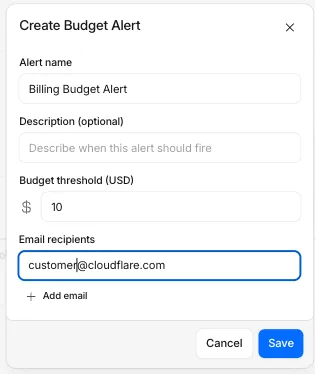
Budget alerts allow you to set dollar-based thresholds for your account-level usage spend. You receive an email notification when your projected monthly spend reaches your configured threshold, giving you proactive visibility into your bill before month-end.
To configure a budget alert:
Go to Manage Account > Billing > Billable Usage.
Select Set Budget Alert.
Enter a budget threshold amount greater than $0.
Select Create.
Alternatively, configure alerts via Notifications > Add > Budget Alert.
You can create multiple budget alerts at different dollar amounts. The notifications system automatically deduplicates alerts if multiple thresholds trigger at the same time. Budget alerts are calculated daily based on your usage trends and fire once per billing cycle when your projected spend first crosses your threshold.
Both features are available to Pay-as-you-go accounts with usage-based products (Workers, R2, Images, etc.). Enterprise contract accounts are not supported.
When a Cloudflare Worker intercepts a visitor request, it can dispatch additional outbound fetch calls called subrequests. By default, each subrequest generates its own log entry in Logpush, resulting in multiple log lines per visitor request. With subrequest merging enabled, subrequest data is embedded as a nested array field on the parent log record instead.
What's new
New subrequest_merging field on Logpush jobs — Set "merge_subrequests": true when creating or updating an http_requests Logpush job to enable the feature.
New Subrequests log field — When subrequest merging is enabled, a Subrequests field (array\<object\>) is added to each parent request log record. Each element in the array contains the standard http_requests fields for that subrequest.
Limitations
Applies to the http_requests (zone-scoped) dataset only.
A maximum of 50 subrequests are merged per parent request. Subrequests beyond this limit are passed through unmodified as individual log entries.
Subrequests must complete within 5 minutes of the visitor request. Subrequests that exceed this window are passed through unmodified.
Subrequests that do not qualify appear as separate log entries — no data is lost.
Subrequest merging is being gradually rolled out and is not yet available on all zones. Contact your account team for concerns or to ensure it is enabled for your zone.
This week's release introduces a new detection for a Remote Code Execution (RCE) vulnerability in Apache ActiveMQ (CVE-2026-34197) and an updated signature for Magento 2 - Unrestricted File Upload. Alongside these detections, we are continuing our work on rule refinements to provide deeper security insights for our customers.
Key Findings
Apache ActiveMQ (CVE-2026-34197): A vulnerability in Apache ActiveMQ allows an unauthenticated, remote attacker to execute arbitrary code. This flaw occurs during the processing of specially crafted network packets, leading to potential full system compromise.
Magento 2 - Unrestricted File Upload - 2: This is a follow-up enhancement to our existing protections for Magento and Adobe Commerce.
Impact
Successful exploitation of these vulnerabilities could allow unauthenticated attackers to execute arbitrary code or gain full administrative control over affected servers. We strongly recommend applying official vendor patches for Apache ActiveMQ and Magento to address the underlying vulnerabilities.
Continuous Rule Improvements
We are continuously refining our managed rules to provide more resilient protection and deeper insights into attack patterns. To ensure an optimal security posture, we recommend consistently monitoring the Security Events dashboard and adjusting rule actions as these enhancements are deployed.
Ruleset
Rule ID
Legacy Rule ID
Description
Previous Action
New Action
Comments
Cloudflare Managed Ruleset
N/A
Command Injection - Generic 8 - uri
Log
Block
This is a new detection. Previous description was "Command Injection - Generic 8 - uri - Beta"
Cloudflare Managed Ruleset
N/A
Command Injection - Generic 8 - body - Beta
Disabled
Disabled
This is a new detection. This rule is merged into the original rule
"Command Injection - Generic 8 - body" (ID: ). The rule previously known as "Command Injection - Generic 8" is now renamed to "Command Injection - Generic 8 - body".
Cloudflare Managed Ruleset
N/A
MySQL - SQLi - Executable Comment - Beta
Log
Block
This is a new detection. This rule is merged into the original rule
"MySQL - SQLi - Executable Comment - Body" (ID: ) The rule previously known as "MySQL - SQLi - Executable Comment" is now renamed to "MySQL - SQLi - Executable Comment - Body".
Binary frames received on a WebSocket are now delivered to the message event as Blob ↗ objects by default. This matches the WebSocket specification ↗ and standard browser behavior. Previously, binary frames were always delivered as ArrayBuffer ↗. The binaryType property on WebSocket controls the delivery type on a per-WebSocket basis.
This change has been active for Workers with compatibility dates on or after 2026-03-17, via the websocket_standard_binary_type compatibility flag. We should have documented this change when it shipped but didn't. We're sorry for the trouble that caused. If your Worker handles binary WebSocket messages and assumes event.data is an ArrayBuffer, the frames will arrive as Blob instead, and a naive instanceof ArrayBuffer check will silently drop every frame.
To opt back into ArrayBuffer delivery, assign binaryType before calling accept(). This works regardless of the compatibility flag:
const resp = await fetch("https://example.com", { headers: { Upgrade: "websocket" },});const ws = resp.webSocket;// Opt back into ArrayBuffer delivery for this WebSocket.ws.binaryType = "arraybuffer";ws.accept();ws.addEventListener("message", (event) => { if (typeof event.data === "string") { // Text frame. } else { // event.data is an ArrayBuffer because we set binaryType above. }});
If you are not ready to migrate and want to keep ArrayBuffer as the default for all WebSockets in your Worker, add the no_websocket_standard_binary_type flag to your Wrangler configuration file.
This change has no effect on the Durable Object hibernatable WebSocket webSocketMessage handler, which continues to receive binary data as ArrayBuffer.
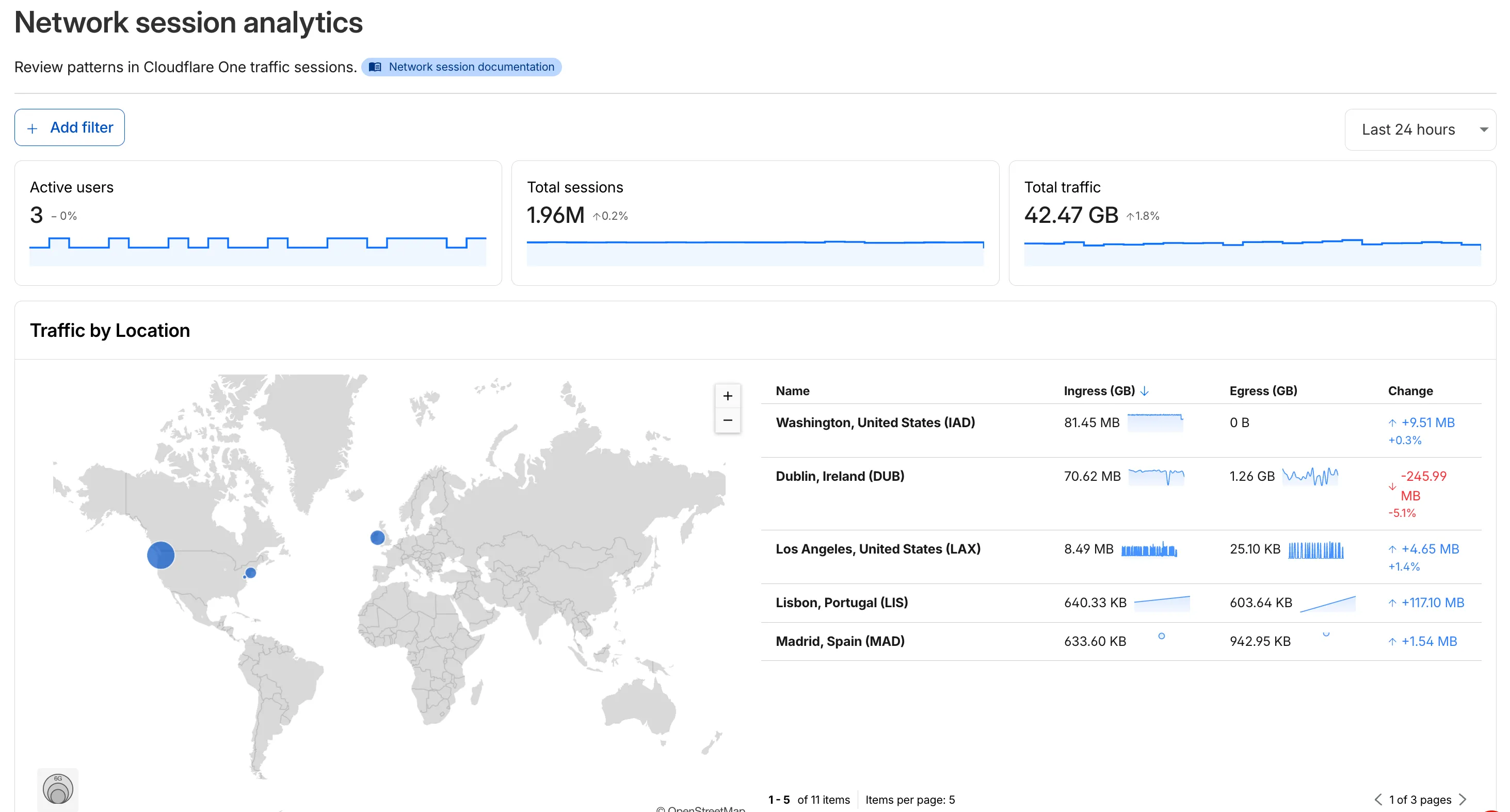
The new Network session analytics dashboard is now available in Cloudflare One. This dashboard provides visibility into your network traffic patterns, helping you understand how traffic flows through your Cloudflare One infrastructure.
What you can do with Network session analytics
Analyze geographic distribution: View a world map showing where your network traffic originates, with a list of top locations by session count.
Monitor key metrics: Track session count, total bytes transferred, and unique users.
Identify connection issues: Analyze connection close reasons to troubleshoot network problems.
Review protocol usage: See which network protocols (TCP, UDP, ICMP) are most used.
Dashboard features
Summary metrics: Session count, bytes total, and unique users
Traffic by location: World map visualization and location list with top traffic sources
Top protocols: Breakdown of TCP, UDP, ICMP, and ICMPv6 traffic
Connection close reasons: Insights into why sessions terminated (client closed, origin closed, timeouts, errors)
Logpush has traditionally been great at delivering Cloudflare logs to a variety of destinations in JSON format. While JSON is flexible and easily readable, it can be inefficient to store and query at scale.
With this release, you can now send your logs directly to Pipelines to ingest, transform, and store your logs in R2 as Parquet files or Apache Iceberg tables managed by R2 Data Catalog. This makes the data footprint more compact and more efficient at querying your logs instantly with R2 SQL or any other query engine that supports Apache Iceberg or Parquet.
Transform logs before storage
Pipelines SQL runs on each log record in-flight, so you can reshape your data before it is written. For example, you can drop noisy fields, redact sensitive values, or derive new columns:
INSERT INTO http_logs_sinkSELECT ClientIP, EdgeResponseStatus, to_timestamp_micros(EdgeStartTimestamp) AS event_time, upper(ClientRequestMethod) AS method, sha256(ClientIP) AS hashed_ipFROM http_logs_streamWHERE EdgeResponseStatus >= 400;
Pipelines SQL supports string functions, regex, hashing, JSON extraction, timestamp conversion, conditional expressions, and more. For the full list, refer to the Pipelines SQL reference.